CCSS.
The Standard
Distinguish among facts, reasoned judgment based on research findings, and speculation in a text.
Common Core State Standards for English Language Arts · Reading Standards for Literacy in Science and Technical Subjects 6—12
Teacher's field guide
What This Standard Means
What Students Need to Do
- Students classify claims in science and technical texts as verifiable information, research-supported conclusions, or untested possibilities. They explain each choice using evidence and wording from the text.
What Mastery Looks Like
- Students accurately label claims and point to specific words, data, or sources that support each label. They explain that a conclusion can be well supported without being a proven fact.
Common Misconceptions
- Students may treat every statement from an expert as a fact. They may also confuse a research-supported conclusion with a personal opinion, or assume any claim using “may” is unsupported.
How to Assess It
- Use this exit ticket: “Three tests showed the filter removed 92 percent of lead. Researchers concluded it works well for homes. It might also remove mercury.” Label each sentence and underline the clue that supports your choice.
Lesson moves
Ways to Teach It
Give pairs printed claims from a lab report and have them sort the cards into facts, research-supported judgments, and speculation.
Ask students to explain in writing which type of claim needs the strongest evidence and why.
Play Claim Detective by awarding points when teams correctly label a sentence and identify the clue that supports their answer.
Compare claims in a weather alert, noting which statements report measurements, interpret data, or predict what could happen.
Free download
Printable RST.6-8.8 Worksheet
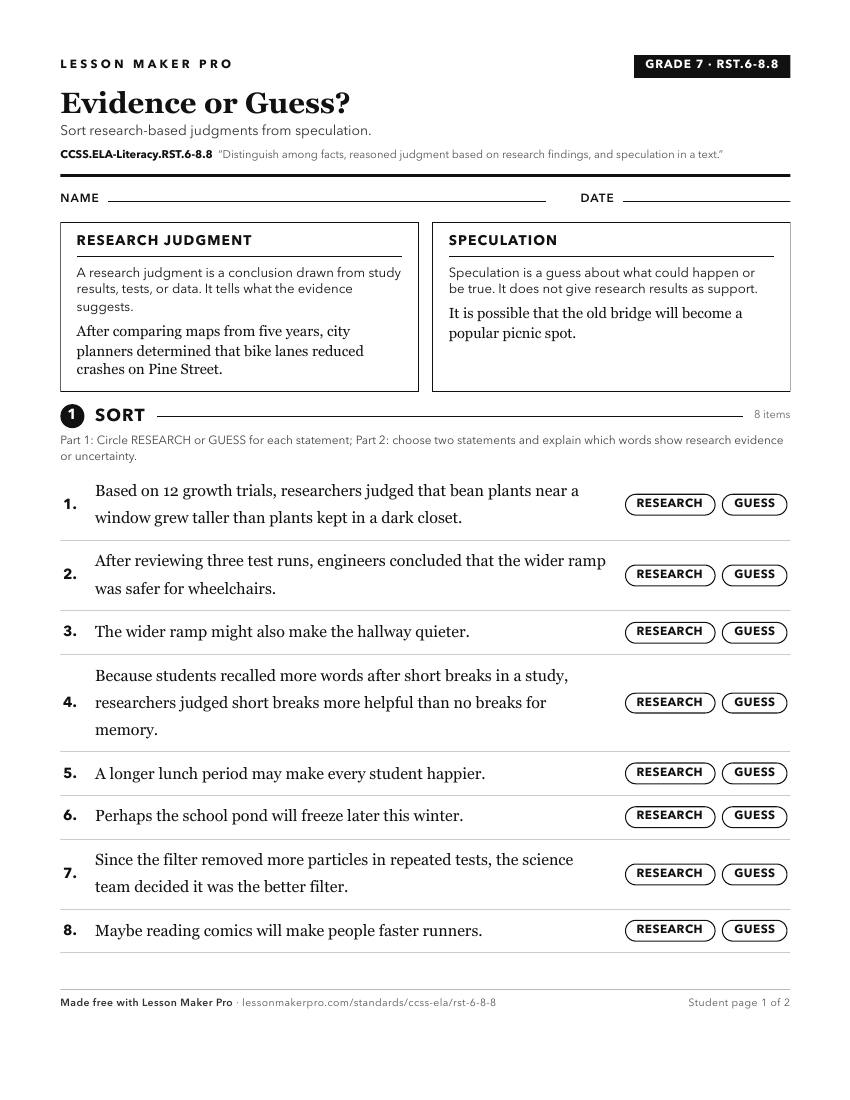
A ready-to-print activity worksheet aligned to CCSS.ELA-Literacy.RST.6-8.8, with an answer key for the teacher on its own page. No account needed.
PDF, US Letter, prints cleanly in black and white.
Download the worksheetKeep exploring
Related Standards
- CCSS.ELA-Literacy.RST.11-12.8
Evaluate the hypotheses, data, analysis, and conclusions in a science or technical text, verifying the data when possible and corroborating or challenging concl...
- CCSS.ELA-Literacy.RH.6-8.8
Distinguish among fact, opinion, and reasoned judgment in a text.
- CCSS.ELA-Literacy.WHST.9-10.9
Draw evidence from informational texts to support analysis, reflection, and research.
- CCSS.ELA-Literacy.WHST.11-12.9
Draw evidence from informational texts to support analysis, reflection, and research.
Turn this exact standard into a lesson
Grade, subject, topic, and the complete standard are prefilled. Create one free, no account needed.
Also for this standard:Make a WorksheetMake a QuizMake a Sub Lesson