CCSS.
The Standard
Sort common objects into categories (e.g., shapes, foods) to gain a sense of the concepts the categories represent.
Common Core State Standards for English Language Arts
Teacher's field guide
What This Standard Means
What Students Need to Do
- Students group familiar objects or pictures by a shared feature, such as shape, use, or type. They name each group and explain what belongs.
What Mastery Looks Like
- Students place familiar items into a sensible group without help. They name the group and tell what the items have in common.
Common Misconceptions
- Students may group items by personal preference instead of a shared feature. They may also focus on color when the intended group is food, shape, or use.
How to Assess It
- Give each student picture cards of an apple, banana, carrot, sock, shoe, and hat. Ask them to make two groups, name each group, and explain their choices.
Lesson moves
Ways to Teach It
Give pairs a basket of classroom objects to sort, then ask them to label each group with a word or picture.
Show a spoon, fork, plate, and ball, then ask, Which item does not belong, and why?
Play Category Corners by naming foods, clothing, toys, and shapes, then have students carry picture cards to the matching corner.
Sort grocery flyers into foods and nonfoods, then create smaller groups such as fruits, vegetables, and drinks.
Free download
Printable L.K.5a Worksheet
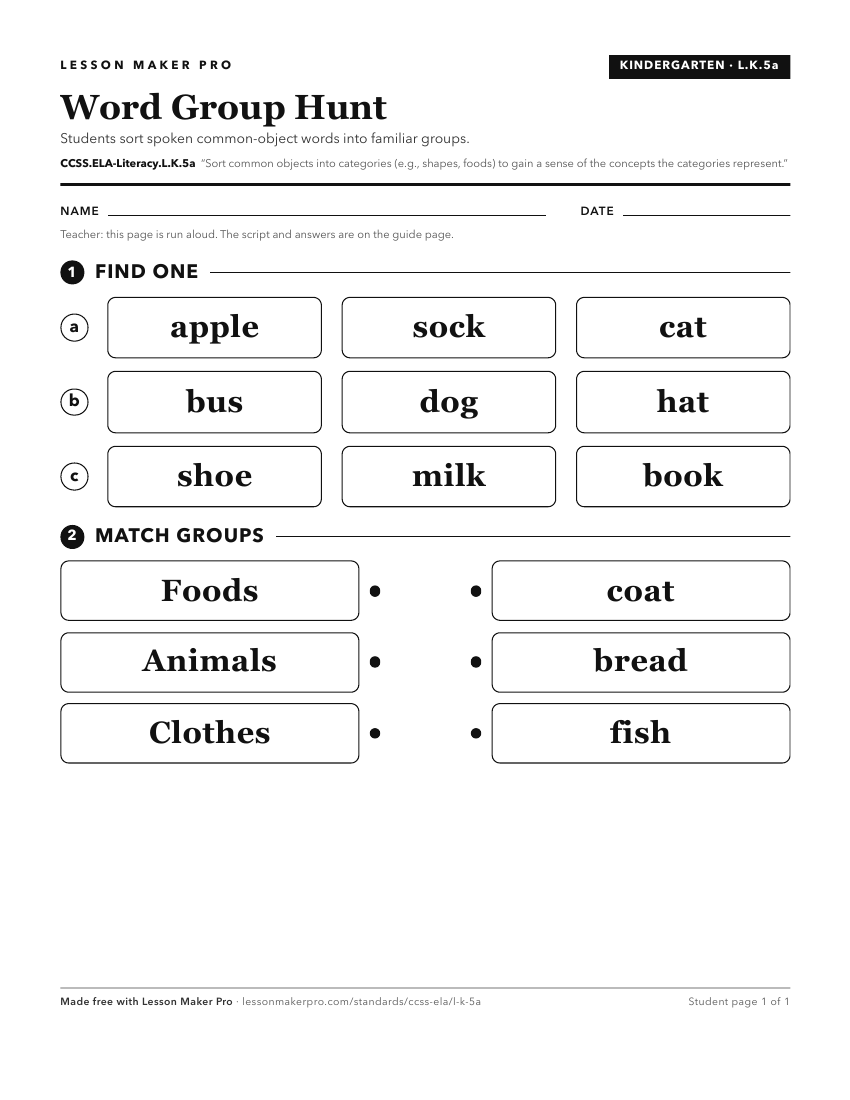
A ready-to-print activity worksheet aligned to CCSS.ELA-Literacy.L.K.5a, with an answer key for the teacher on its own page. No account needed.
PDF, US Letter, prints cleanly in black and white.
Download the worksheetLearning progression
Where This Standard Sits
What This Unlocks
Mastery here sets students up for these next.
Keep exploring
Related Standards
- CCSS.ELA-Literacy.L.6.5b
Use the relationship between particular words (e.g., cause/effect, part/whole, item/category) to better understand each of the words.
- CCSS.ELA-Literacy.L.1.5b
Define words by category and by one or more key attributes (e.g., a duck is a bird that swims; a tiger is a large cat with stripes).
- CCSS.ELA-Literacy.RST.11-12.5
Analyze how the text structures information or ideas into categories or hierarchies, demonstrating understanding of the information or ideas.
Turn this exact standard into a lesson
Grade, subject, topic, and the complete standard are prefilled. Create one free, no account needed.
Also for this standard:Make a WorksheetMake a QuizMake a Sub Lesson