CCSS.
The Standard
Use a colon to introduce a list or quotation.
Common Core State Standards for English Language Arts
Teacher's field guide
What This Standard Means
What Students Need to Do
- Students decide whether the words before a list or quotation form a complete sentence. When they do, students place a colon between that lead-in and the material that follows.
What Mastery Looks Like
- A student can write one sentence introducing a list and one introducing a quotation, with a complete clause before each colon. The student can also correct a misplaced colon and explain the change.
Common Misconceptions
- Students often put a colon directly after a verb or preposition, as in “The supplies are: paper and glue.” They may add one after phrases such as “including” or “such as.” They may also use a colon before every quotation, even when a comma fits a dialogue tag.
How to Assess It
- Exit ticket: Rewrite both sentences so a colon is correct: Maya packed a compass, water, and a map. The coach repeated one reminder, “Stay focused.”
Lesson moves
Ways to Teach It
Give pairs sentence strips with complete and incomplete lead-ins, then have them match list or quotation endings and add colons where correct.
Ask students to explain why the colon works in “Bring three tools: scissors, tape, and a ruler” but fails in “Bring: scissors and tape.”
Play Colon or No Colon by displaying sentences and having teams hold up punctuation cards, then justify each choice.
Project a menu, safety poster, and news article, then have students locate or revise colons that introduce lists and quotations.
Free download
Printable L.9-10.2b Worksheet
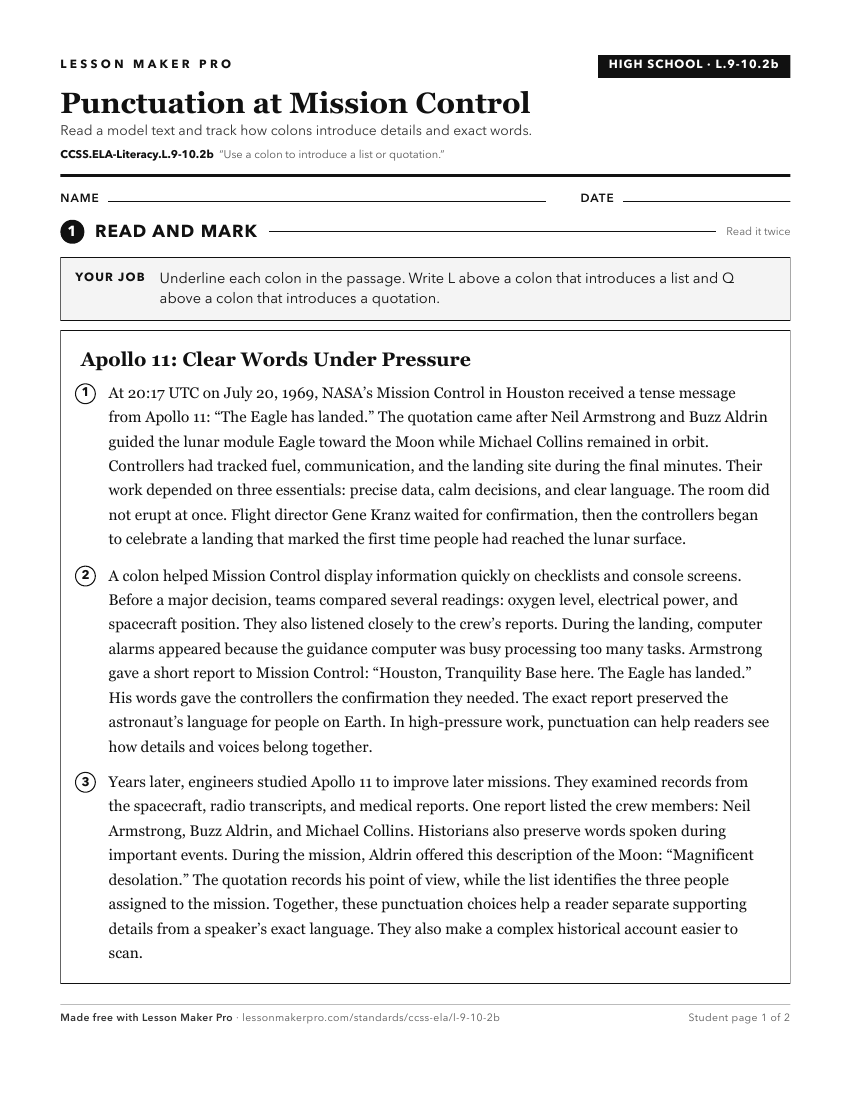
A ready-to-print activity worksheet aligned to CCSS.ELA-Literacy.L.9-10.2b, with an answer key for the teacher on its own page. No account needed.
PDF, US Letter, prints cleanly in black and white.
Download the worksheetKeep exploring
Related Standards
- CCSS.ELA-Literacy.L.4.2b
Use commas and quotation marks to mark direct speech and quotations from a text.
- CCSS.ELA-Literacy.L.9-10.2a
Use a semicolon (and perhaps a conjunctive adverb) to link two or more closely related independent clauses.
- CCSS.ELA-Literacy.L.5.2a
Use punctuation to separate items in a series.
- CCSS.ELA-Literacy.L.5.2b
Use a comma to separate an introductory element from the rest of the sentence.
Turn this exact standard into a lesson
Grade, subject, topic, and the complete standard are prefilled. Create one free, no account needed.
Also for this standard:Make a WorksheetMake a QuizMake a Sub Lesson