CCSS.
The Standard
Use intensive pronouns (e.g., myself, ourselves).
Common Core State Standards for English Language Arts
Teacher's field guide
What This Standard Means
What Students Need to Do
- Students use intensive pronouns to emphasize a specific noun or pronoun. They choose the form that agrees with the person or group being emphasized.
What Mastery Looks Like
- A student can place an intensive pronoun next to the noun or pronoun it emphasizes. They match person and number, and the sentence remains complete when the pronoun is removed.
Common Misconceptions
- Students may use forms such as “myself” as subjects, as in “Myself finished first.” They may also confuse emphasis with a reflexive use that completes the sentence’s meaning.
How to Assess It
- Give this exit ticket: Revise “The coach handed out every uniform” to emphasize who did it, then circle the intensive pronoun. Rewrite it without the pronoun.
Lesson moves
Ways to Teach It
Give pairs noun cards and pronoun cards, then have students match them and build emphasis sentences with each pair.
Ask students to write three sentences emphasizing who completed a difficult task, then explain what each intensive pronoun adds.
Play Pronoun Detective by having teams remove bold pronouns and decide whether each one adds emphasis or completes the sentence.
Examine sports interviews or advertisements for phrases like “the players themselves,” then discuss why the speaker adds that emphasis.
Free download
Printable L.6.1b Worksheet
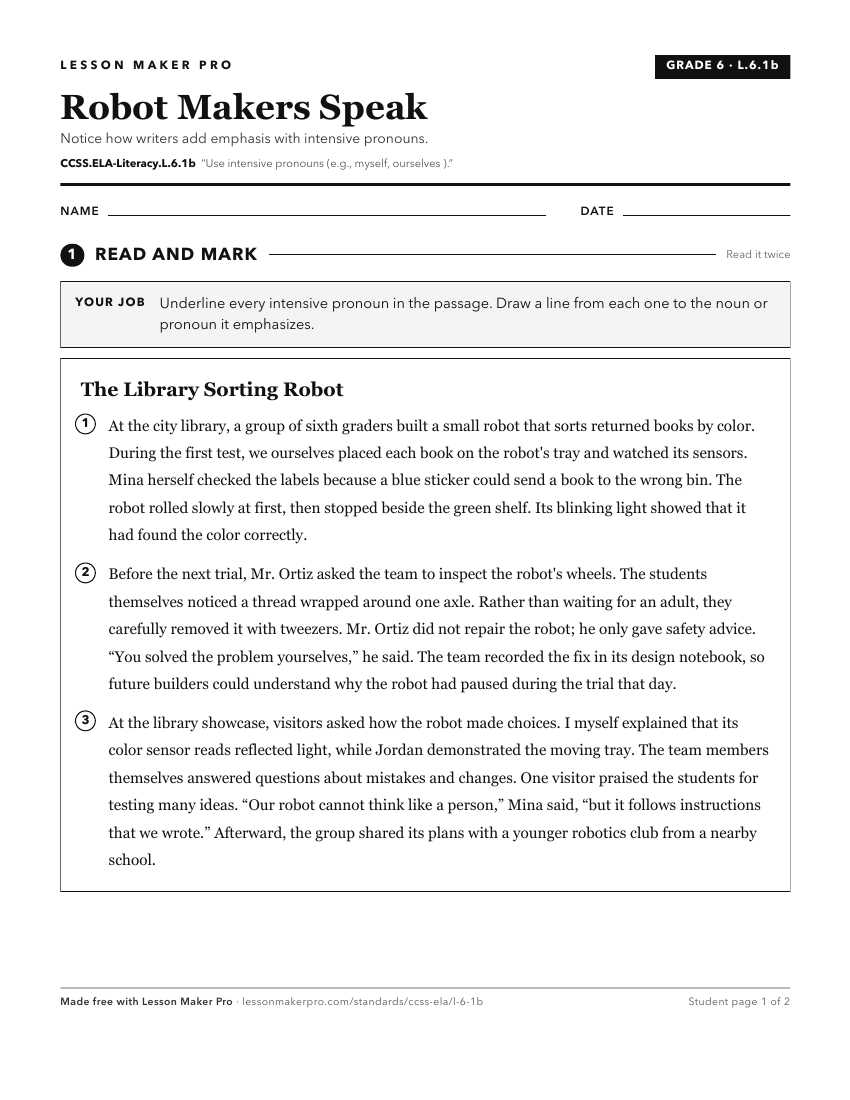
A ready-to-print activity worksheet aligned to CCSS.ELA-Literacy.L.6.1b, with an answer key for the teacher on its own page. No account needed.
PDF, US Letter, prints cleanly in black and white.
Download the worksheetKeep exploring
Related Standards
- CCSS.ELA-Literacy.L.3.2d
Form and use possessives.
- CCSS.ELA-Literacy.L.1.1d
Use personal, possessive, and indefinite pronouns (e.g., I, me, my; they, them, their; anyone, everything).
- CCSS.ELA-Literacy.L.6.1a
Ensure that pronouns are in the proper case (subjective, objective, possessive).
- CCSS.ELA-Literacy.L.2.1c
Use reflexive pronouns (e.g., myself, ourselves).
Turn this exact standard into a lesson
Grade, subject, topic, and the complete standard are prefilled. Create one free, no account needed.
Also for this standard:Make a WorksheetMake a QuizMake a Sub Lesson