CCSS.
The Standard
Form and use comparative and superlative adjectives and adverbs, and choose between them depending on what is to be modified.
Common Core State Standards for English Language Arts
Teacher's field guide
What This Standard Means
What Students Need to Do
- Students form words that compare two things and words that identify the highest or lowest among three or more. They choose adjective forms for nouns and adverb forms for actions.
What Mastery Looks Like
- Students correctly use forms such as taller, tallest, more carefully, and most carefully. They choose an adjective to describe a noun and an adverb to describe an action.
Common Misconceptions
- Students may use a superlative when comparing only two things, such as “the fastest of the two.” They may also write forms like “more faster” or use an adjective for an action, as in “She ran quick.”
How to Assess It
- Give this exit ticket: “Mia runs ___ than Lee. Of all three runners, Ana runs the ___.” Students fill in the blanks and explain their choices.
Lesson moves
Ways to Teach It
Give groups three pencils to measure, then have them label each with long, longer, or longest and explain their choices.
Ask students to write two sentences comparing classmates’ imaginary pets, using one comparative adjective and one superlative adverb.
Play a sorting relay with word cards such as faster, fastest, louder, and loudest under headings for two or three comparisons.
Use weather data from three cities, then write comparisons such as warmer, warmest, more quickly, or most quickly.
Free download
Printable L.3.1g Worksheet
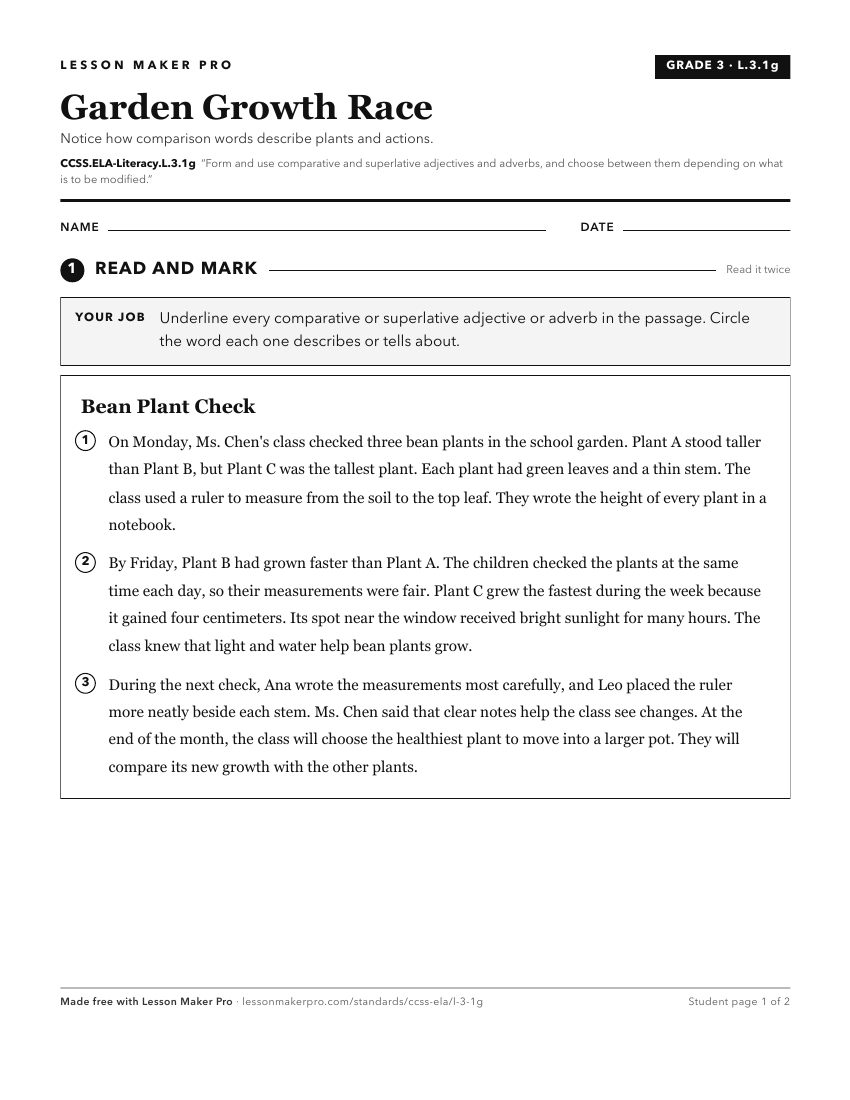
A ready-to-print activity worksheet aligned to CCSS.ELA-Literacy.L.3.1g, with an answer key for the teacher on its own page. No account needed.
PDF, US Letter, prints cleanly in black and white.
Download the worksheetKeep exploring
Related Standards
- CCSS.ELA-Literacy.L.4.1a
Use relative pronouns (who, whose, whom, which, that) and relative adverbs (where, when, why).
- CCSS.ELA-Literacy.L.1.1f
Use frequently occurring adjectives.
- CCSS.ELA-Literacy.L.4.1d
Order adjectives within sentences according to conventional patterns (e.g., a small red bag rather than a red small bag).
- CCSS.ELA-Literacy.L.2.1e
Use adjectives and adverbs, and choose between them depending on what is to be modified.
Turn this exact standard into a lesson
Grade, subject, topic, and the complete standard are prefilled. Create one free, no account needed.
Also for this standard:Make a WorksheetMake a QuizMake a Sub Lesson