CCSS.
The Standard
Assess how point of view or purpose shapes the content and style of a text.
Common Core State Standards for English Language Arts · College and Career Readiness Anchor Standards for Reading
Teacher's field guide
What This Standard Means
What Students Need to Do
- Students identify who is speaking or writing and why the text was created. They explain how that perspective or goal affects the details, language, tone, and structure.
What Mastery Looks Like
- Students can identify the narrator’s perspective or the author’s goal and support it with evidence. They can explain how word choice, selected details, tone, or structure would change with a different perspective or goal.
Common Misconceptions
- Students may confuse the author with the narrator or speaker. They may name a viewpoint or purpose without showing which details, words, or structural choices reveal it.
How to Assess It
- Give students a short opinion paragraph and ask: “What does the writer want readers to think or do? Name two choices that support your answer.”
Lesson moves
Ways to Teach It
Give groups sentence strips from two accounts of one event, then have them sort the details by each speaker’s perspective.
Ask students to write: “Which words reveal the writer’s attitude, and how would the passage change if the attitude changed?”
Play Purpose Detective with short passages, where teams identify the likely goal and earn points by citing two supporting choices.
Compare a product advertisement with a customer review, then list how each source selects details and uses language differently.
Free download
Printable CCRA.R.6 Worksheet
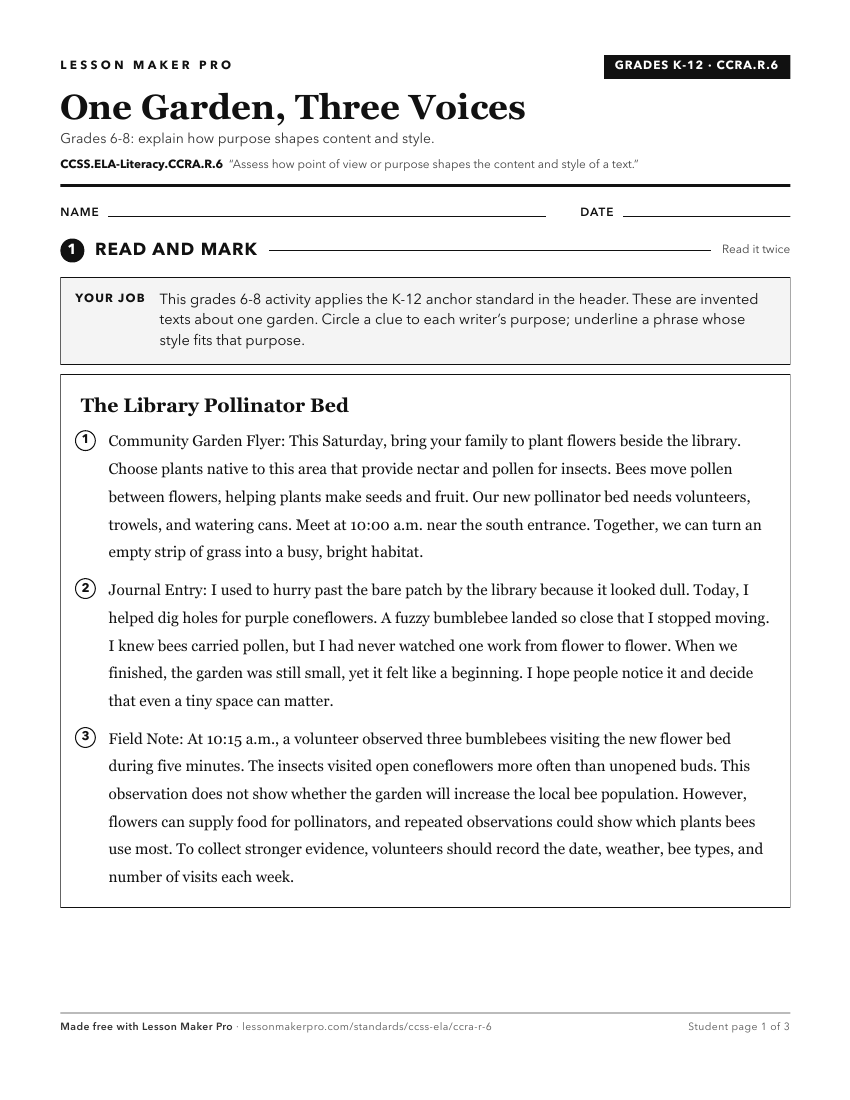
A ready-to-print activity worksheet aligned to CCSS.ELA-Literacy.CCRA.R.6, with an answer key for the teacher on its own page. No account needed.
PDF, US Letter, prints cleanly in black and white.
Download the worksheetKeep exploring
Related Standards
- CCSS.ELA-Literacy.RI.11-12.6
Determine an author's point of view or purpose in a text in which the rhetoric is particularly effective, analyzing how style and content contribute to the powe...
- CCSS.ELA-Literacy.RI.6.6
Determine an author's point of view or purpose in a text and explain how it is conveyed in the text.
- CCSS.ELA-Literacy.RI.7.6
Determine an author's point of view or purpose in a text and analyze how the author distinguishes his or her position from that of others.
- CCSS.ELA-Literacy.RH.6-8.6
Identify aspects of a text that reveal an author's point of view or purpose (e.g., loaded language, inclusion or avoidance of particular facts).
Turn this exact standard into a lesson
Grade, subject, topic, and the complete standard are prefilled. Create one free, no account needed.
Also for this standard:Make a WorksheetMake a QuizMake a Sub Lesson