NGSS 5-LS1-1
The Standard
Support an argument that plants get the materials they need for growth chiefly from air and water.
Next Generation Science Standards
Teacher's field guide
What This Standard Means
What Students Need to Do
- Students use observations and data to explain where a plant’s added mass comes from. They argue that carbon dioxide and water provide most of that matter, then support the claim with evidence.
What Mastery Looks Like
- A student can read growth data and reject soil as the source of nearly all added mass. They cite evidence and explain that sunlight supplies energy, while carbon dioxide and water supply matter. They recognize minerals as small inputs.
Common Misconceptions
- Students often think plants eat soil or that fertilizer becomes most of the plant. They may treat sunlight as matter instead of energy. Some think air has no mass or that water only prevents wilting.
How to Assess It
- Give this exit ticket: “A seedling gains 120 grams while its dry soil loses 2 grams. It receives water, air, and sunlight. Explain the mass gain using evidence.”
Lesson moves
Ways to Teach It
Set up identical bean plants in weighed soil, add measured water, and track plant growth and soil mass for two weeks.
Write a claim for this prompt: A tree gains 50 kilograms, but its soil loses only 1 kilogram. Where did the matter come from?
Sort cards labeled carbon dioxide, water, sunlight, and soil minerals into matter sources, energy sources, and minor inputs.
Examine a hydroponic lettuce system, then explain how plants can gain mass while growing without soil.
Free download
Printable 5-LS1-1 Worksheet
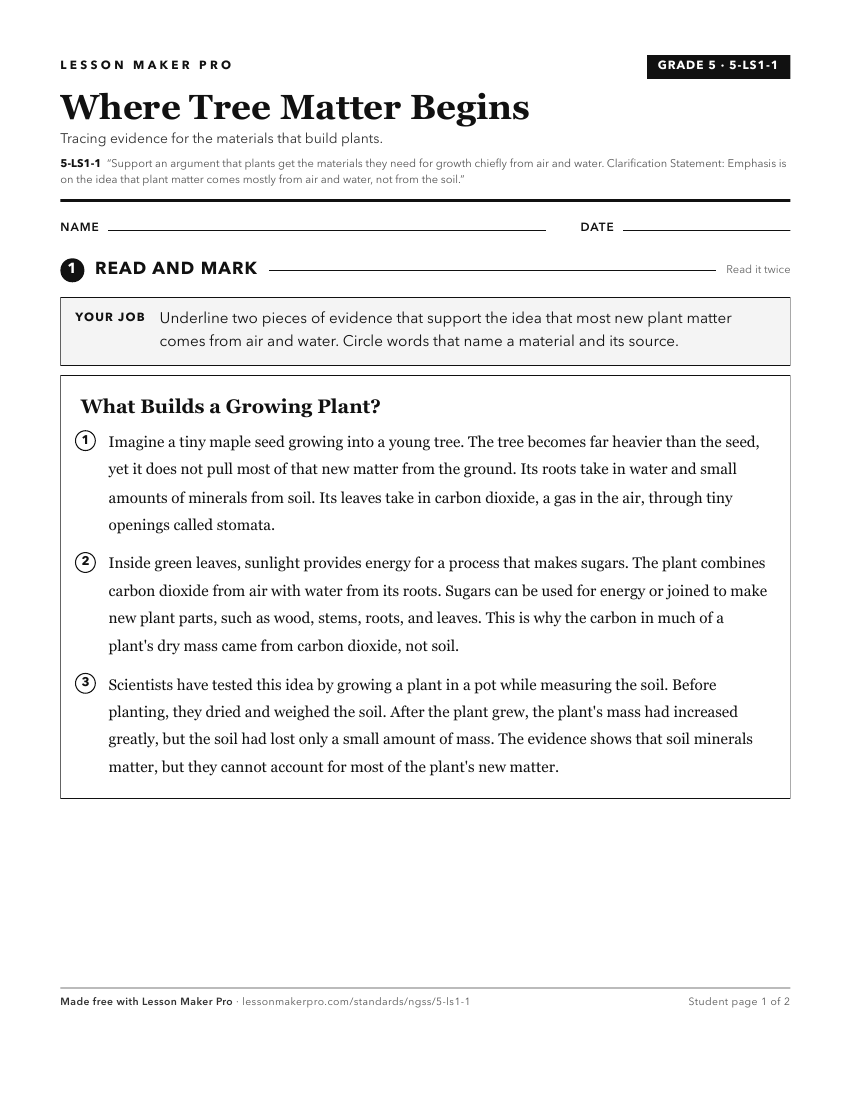
A ready-to-print activity worksheet aligned to 5-LS1-1, with an answer key for the teacher on its own page. No account needed.
PDF, US Letter, prints cleanly in black and white.
Download the worksheetWhat This Unlocks
Mastery here sets students up for these next.
Keep exploring
Related Standards
- K-ESS2-2
Construct an argument supported by evidence for how plants and animals (including humans) can change the environment to meet their needs.
- 5-PS2-1
Support an argument that the gravitational force exerted by Earth on objects is directed down.
- 4-LS1-1
Construct an argument that plants and animals have internal and external structures that function to support survival, growth, behavior, and reproduction.
Turn this exact standard into a lesson
Grade, subject, topic, and the complete standard are prefilled. Create one free, no account needed.
Also for this standard:Make a WorksheetMake a QuizMake a Sub Lesson