CCSS.
The Standard
Explain how the definition of the meaning of rational exponents follows from extending the properties of integer exponents to those values, allowing for a notation for radicals in terms of rational exponents.
Common Core State Standards for Mathematics · The Real Number System
Teacher's field guide
What This Standard Means
What Students Need to Do
- Students use familiar exponent rules to explain why a fractional exponent names a root. They rewrite a^(m/n) as an nth root raised to the mth power, then justify why the forms are equivalent.
What Mastery Looks Like
- A student can explain why 16^(1/4) = 2 by checking that raising 2 to the fourth power returns 16. The student can rewrite and evaluate expressions such as 27^(2/3) as (cube root of 27)^2.
Common Misconceptions
- Students may treat a^(1/n) as a divided by n, or as 1/a^n. They may reverse the roles of m and n in a^(m/n). They may give a real value for an even root of a negative number.
How to Assess It
- Exit ticket: Explain why 27^(2/3) = 9. Rewrite it in radical form and use an exponent rule to justify each step.
Lesson moves
Ways to Teach It
Give students cards showing rational exponents, radical forms, and values, then have them form matching sets and justify each match.
Ask students to write: Why must x^(1/4) be the fourth root of x if the power-of-a-power rule remains true?
Play exponent bingo by calling a radical form or value while students cover the equivalent rational exponent and explain one match to win.
Use a cube with volume 125 cubic centimeters to connect its side length, cube root of 125, and 125^(1/3).
Free download
Printable HSN-RN.A.1 Worksheet
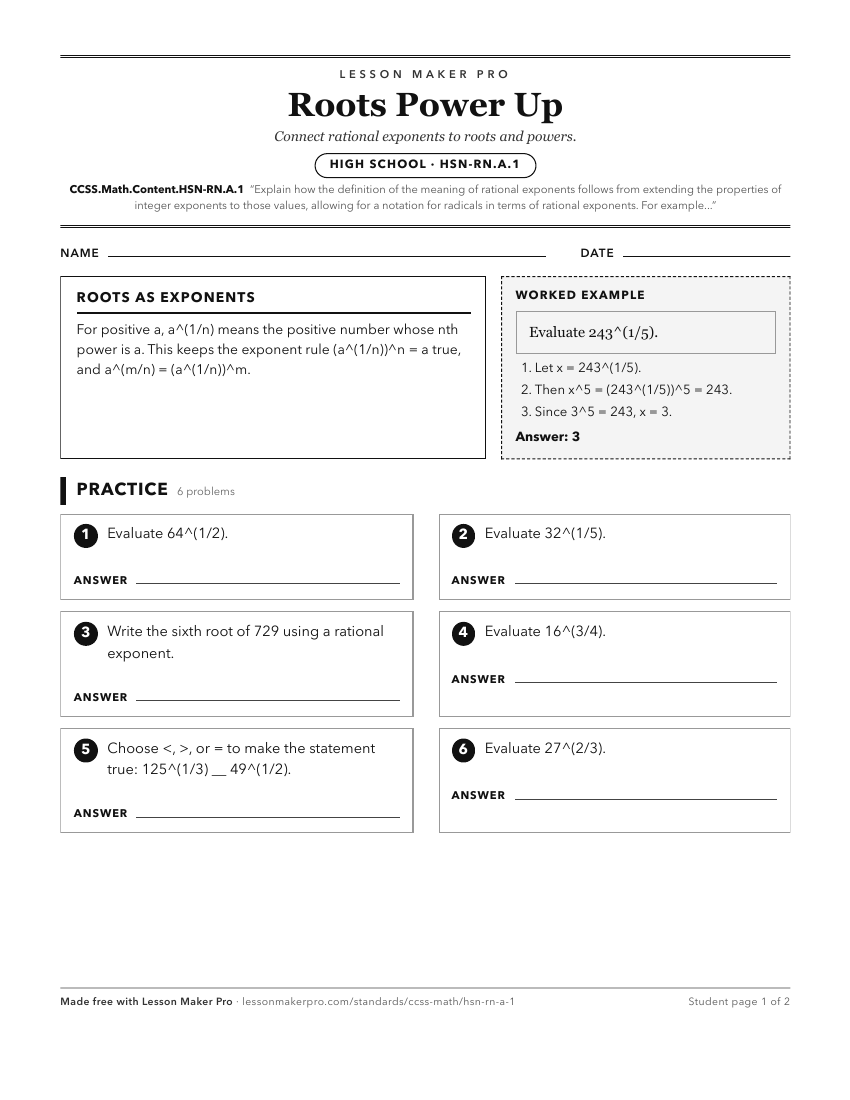
A ready-to-print activity worksheet aligned to CCSS.Math.Content.HSN-RN.A.1, with an answer key for the teacher on its own page. No account needed.
PDF, US Letter, prints cleanly in black and white.
Download the worksheetLearning progression
Where This Standard Sits
Before This Standard
If students are struggling here, check these first.
- CCSS.Math.Content.8.EE.A.2
Square and cube root notation and meanings prepare students to see fractional exponents as another way to write roots.
- CCSS.Math.Content.8.EE.A.1
Rational exponents are defined by preserving integer exponent rules, especially powers of powers and products, when exponents become fractions.
- CCSS.Math.Content.7.NS.A.2
Multiplying and dividing rational numbers supports working with fractional exponents when extending integer exponent rules to radicals.
What This Unlocks
Mastery here sets students up for these next.
Keep exploring
Related Standards
- CCSS.Math.Content.HSN-RN.B
Use properties of rational and irrational numbers.
- CCSS.Math.Content.7.NS.A.2a
Understand that multiplication is extended from fractions to rational numbers by requiring that operations continue to satisfy the properties of operations, par...
- CCSS.Math.Content.HSN-RN.A
Extend the properties of exponents to rational exponents.
Turn this exact standard into a lesson
Grade, subject, topic, and the complete standard are prefilled. Create one free, no account needed.
Also for this standard:Make a WorksheetMake a QuizMake a Sub Lesson