CCSS.
The Standard
Solve quadratic equations with real coefficients that have complex solutions.
Common Core State Standards for Mathematics · The Complex Number System
Teacher's field guide
What This Standard Means
What Students Need to Do
- Students use the quadratic formula or complete the square when a negative value appears under a square root. They rewrite √(-a) as i√a, simplify, and report both conjugate roots.
What Mastery Looks Like
- Given x² + 4x + 13 = 0, a student finds -2 + 3i and -2 - 3i with clear steps. The student can substitute either root, use i² = -1, and get zero.
Common Misconceptions
- Students may stop at a negative square root and say there is no solution. They may write √(-36) as -6, forget the ± sign, or treat i² as 1. Some miss that nonreal roots occur as a conjugate pair.
How to Assess It
- Exit ticket: Solve 2x² + 4x + 10 = 0, then verify one root by substitution. Circle the step where i is introduced.
Lesson moves
Ways to Teach It
Give groups cards showing quadratic equations, discriminants, and solution pairs; have them build three-card matches and justify each match.
Ask students to explain why x² + 6x + 13 has no real zeros but still has two complex roots.
Run an error-analysis relay with worked solutions containing a missed ±, a sign error, or i² = 1; teams correct each page.
Give h(t) = t² - 4t + 8 for a machine's clearance, solve h(t) = 0, and explain why no real collision time exists.
Free download
Printable HSN-CN.C.7 Worksheet
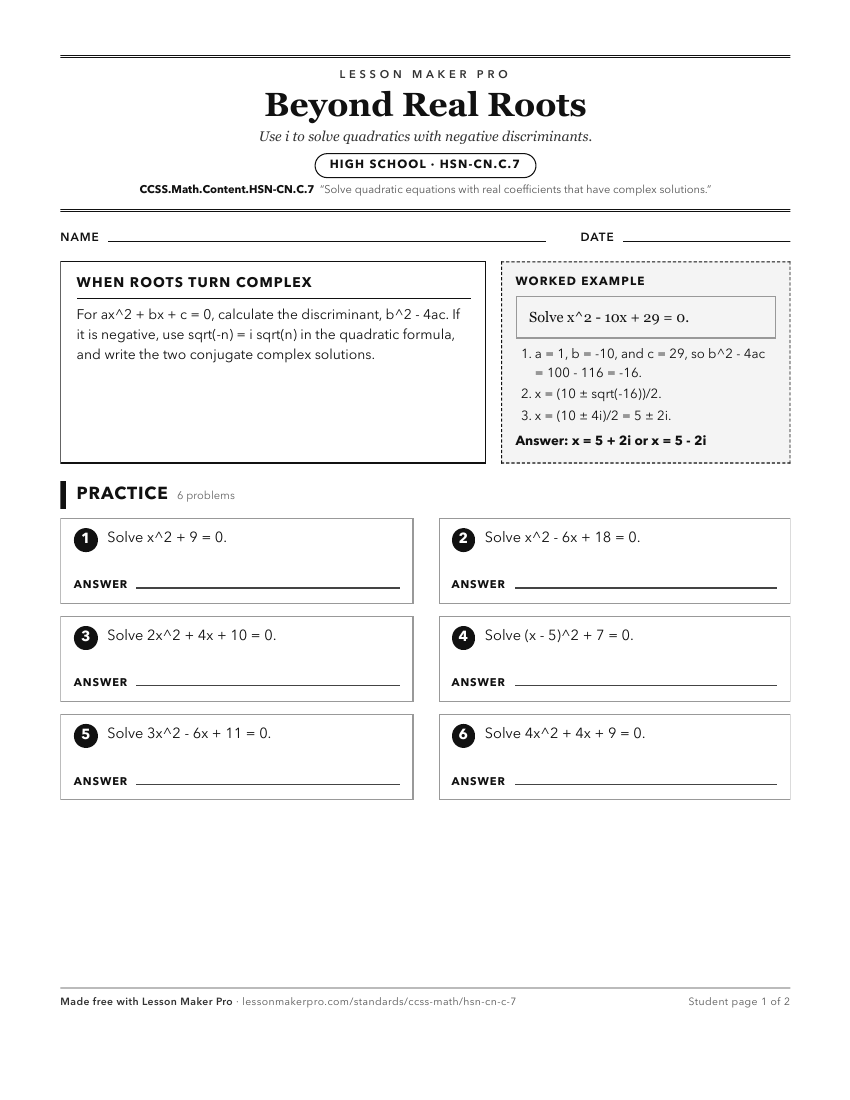
A ready-to-print activity worksheet aligned to CCSS.Math.Content.HSN-CN.C.7, with an answer key for the teacher on its own page. No account needed.
PDF, US Letter, prints cleanly in black and white.
Download the worksheetLearning progression
Where This Standard Sits
Before This Standard
If students are struggling here, check these first.
What This Unlocks
Mastery here sets students up for these next.
Keep exploring
Related Standards
- CCSS.Math.Content.HSN-CN.C
Use complex numbers in polynomial identities and equations.
- CCSS.Math.Content.HSA-REI.B.4b
Solve quadratic equations by inspection (e.g., for x² = 49), taking square roots, completing the square, the quadratic formula and factoring, as appropriate to ...
- CCSS.Math.Content.8.EE.C.8c
Solve real-world and mathematical problems leading to two linear equations in two variables.
Turn this exact standard into a lesson
Grade, subject, topic, and the complete standard are prefilled. Create one free, no account needed.
Also for this standard:Make a WorksheetMake a QuizMake a Sub Lesson