CCSS.
The Standard
Give examples of linear equations in one variable with one solution, infinitely many solutions, or no solutions. Show which of these possibilities is the case by successively transforming the given equation into simpler forms, until an equivalent equation of the form x = a, a = a, or a = b results (where a and b are different numbers).
Common Core State Standards for Mathematics
Teacher's field guide
What This Standard Means
What Students Need to Do
- Students simplify linear equations while keeping both sides equal. They use the final result to decide whether one value works, every value works, or no value works, then create examples of each.
What Mastery Looks Like
- A student simplifies equations with variables on both sides and correctly identifies one solution, no solution, or infinitely many solutions. They can also write an example of each type and explain why it fits.
Common Misconceptions
- Students often read a true statement such as 6 = 6 as meaning x = 6, rather than every value works. They may treat a false statement such as 2 = 9 as a calculation error instead of evidence that no value works. Some also move terms across the equal sign without applying the same operation to both sides.
How to Assess It
- Give this exit ticket: Solve and classify 3x + 5 = 17, 2(x + 3) = 2x + 6, and 4x - 1 = 4x + 7. Show each step.
Lesson moves
Ways to Teach It
Use algebra tiles to model three equations, then remove equal pieces from both sides and classify each result.
Have students explain why 4x + 6 = 4x + 6 has every number as a solution, not just zero.
Play Equation Sort: teams simplify equation cards and place them under one solution, no solution, or infinitely many solutions.
Compare two taxi fare rules and decide whether their costs are equal once, always, or never.
Free download
Printable 8.EE.C.7a Worksheet
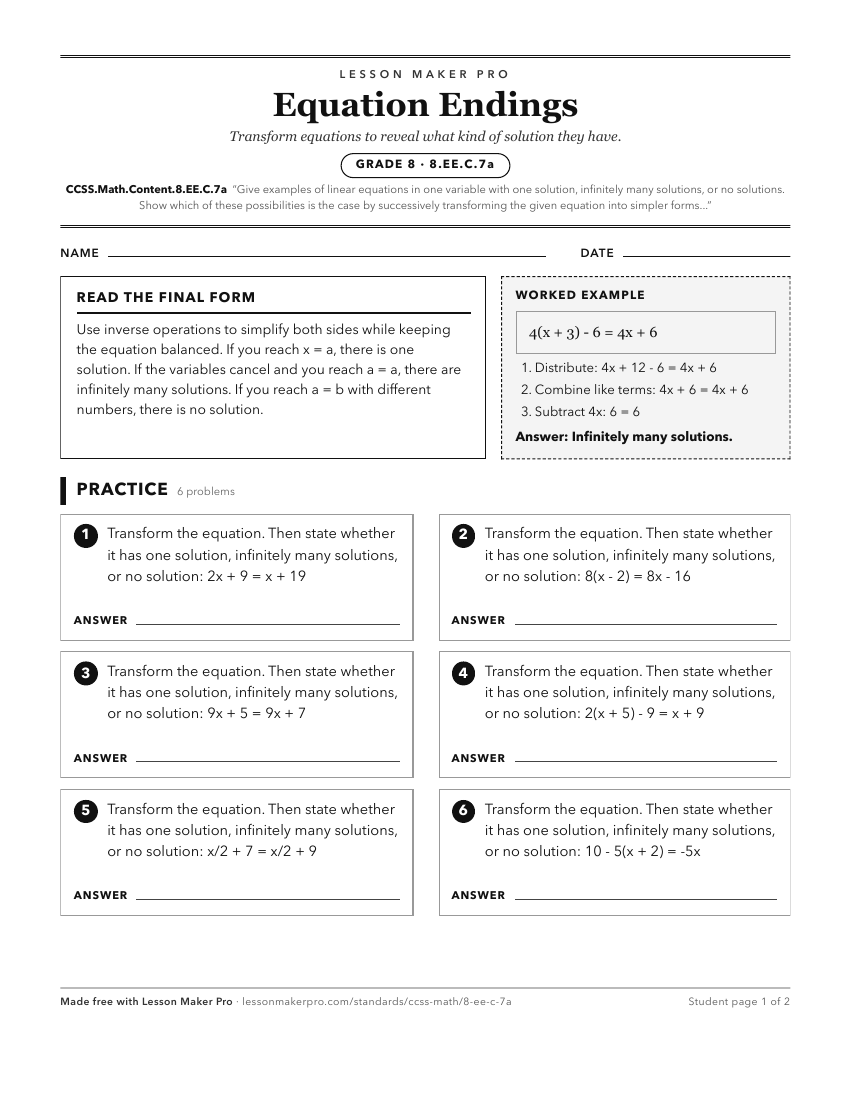
A ready-to-print activity worksheet aligned to CCSS.Math.Content.8.EE.C.7a, with an answer key for the teacher on its own page. No account needed.
PDF, US Letter, prints cleanly in black and white.
Download the worksheetLearning progression
Where This Standard Sits
Before This Standard
If students are struggling here, check these first.
- CCSS.Math.Content.6.EE.B.5
Substitution and the meaning of a solution carry into recognizing when transformed equations are true, false, or give one value.
- CCSS.Math.Content.7.EE.B.4a
Fluently undoing operations and using equivalent equations carries into simplifying linear equations to one solution, no solution, or infinitely many.
- CCSS.Math.Content.7.EE.A.1
Simplifying equations to x = a, a = a, or a = b requires distributing and combining linear expressions with rational coefficients.
Keep exploring
Related Standards
- CCSS.Math.Content.HSA-REI.A.2
Solve simple rational and radical equations in one variable, and give examples showing how extraneous solutions may arise.
- CCSS.Math.Content.HSA-CED.A.1
Create equations and inequalities in one variable and use them to solve problems. Include equations arising from linear and quadratic functions, and simple rati...
- CCSS.Math.Content.8.EE.C.7
Solve linear equations in one variable.
- CCSS.Math.Content.HSA-REI.B.3
Solve linear equations and inequalities in one variable, including equations with coefficients represented by letters.
Turn this exact standard into a lesson
Grade, subject, topic, and the complete standard are prefilled. Create one free, no account needed.
Also for this standard:Make a WorksheetMake a QuizMake a Sub Lesson