CCSS.
The Standard
Write an inequality of the form x > c or x < c to represent a constraint or condition in a real-world or mathematical problem. Recognize that inequalities of the form x > c or x < c have infinitely many solutions; represent solutions of such inequalities on number line diagrams.
Common Core State Standards for Mathematics · Expressions and Equations
Teacher's field guide
What This Standard Means
What Students Need to Do
- Students identify a boundary value in a situation and decide which values lie above or below it. They write the matching strict inequality and graph all solutions with an open circle and a ray. They explain why the solution set continues without end.
What Mastery Looks Like
- Given “children taller than 48 inches may ride,” a student writes h > 48 and graphs an open circle at 48 with a ray right. The student can test values, reject 48 itself, and explain that infinitely many numbers satisfy the condition.
Common Misconceptions
- Students often reverse the inequality sign when the variable is on the left. They may use a filled circle even though the boundary value is excluded. Some plot only whole-number solutions instead of showing every possible number along the ray.
How to Assess It
- Exit ticket: “A package must weigh less than 12.5 kilograms. Write an inequality, graph its solutions, and state whether 12.5 and 10 are solutions.”
Lesson moves
Ways to Teach It
Make a masking-tape number line, then have students place an open-circle marker at the boundary and stretch yarn toward all possible solutions.
Ask, “Does x > 4 include 4, 4.1, and 100? Explain each choice using the graph.”
Play Inequality Match with cards showing situations, inequalities, test values, and number-line graphs; teams assemble matching sets.
Use amusement-ride height signs to compare “taller than 48 inches” with “at least 48 inches” and discuss who may ride.
Free download
Printable 6.EE.B.8 Worksheet
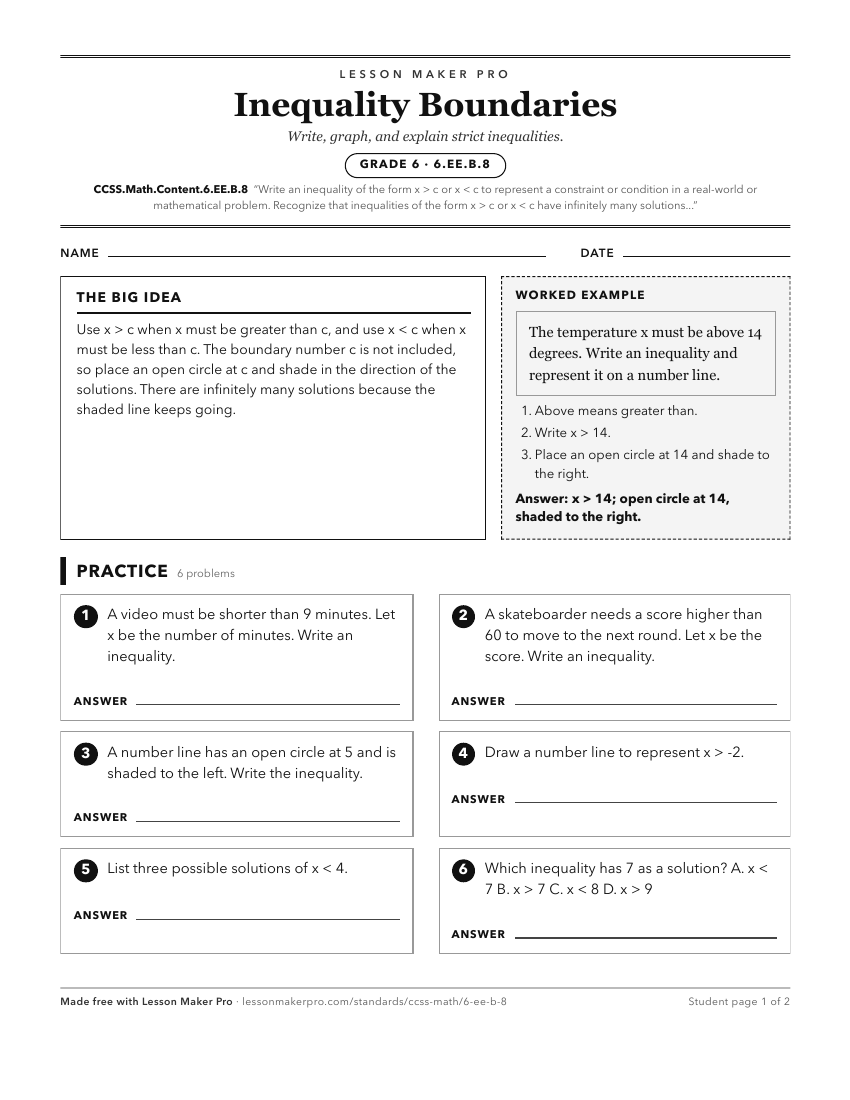
A ready-to-print activity worksheet aligned to CCSS.Math.Content.6.EE.B.8, with an answer key for the teacher on its own page. No account needed.
PDF, US Letter, prints cleanly in black and white.
Download the worksheetLearning progression
Where This Standard Sits
See the whole path on the Expressions & Equations progression map.
Before This Standard
If students are struggling here, check these first.
- CCSS.Math.Content.6.NS.C.7a
Interpreting inequality signs on a number line supports writing simple inequalities and graphing their solution sets.
- CCSS.Math.Content.6.EE.B.5
Testing values in inequalities supports understanding which numbers satisfy x > c or x < c and why solutions form a ray.
- CCSS.Math.Content.6.EE.B.6
Understanding a variable as any number in a set supports seeing x > c as a condition with many solutions.
What This Unlocks
Mastery here sets students up for these next.
- CCSS.Math.Content.7.EE.B.4b
Students must understand simple inequality solution sets and number-line graphs before solving and interpreting multi-step inequality word problems.
- CCSS.Math.Content.7.EE.B.4
Writing and graphing simple inequality constraints supports forming and solving more complex variable inequalities from real-world situations.
Keep exploring
Related Standards
- CCSS.Math.Content.HSA-CED.A.3
Represent constraints by equations or inequalities, and by systems of equations and/or inequalities, and interpret solutions as viable or nonviable options in a...
- CCSS.Math.Content.HSA-REI.D.12
Graph the solutions to a linear inequality in two variables as a half-plane (excluding the boundary in the case of a strict inequality), and graph the solution ...
Turn this exact standard into a lesson
Grade, subject, topic, and the complete standard are prefilled. Create one free, no account needed.
Also for this standard:Make a WorksheetMake a QuizMake a Sub Lesson