CCSS.
Standard Cluster
Understand place value.
Common Core State Standards for Mathematics
Cluster contents
Standards in This Cluster
CCSS.Math.Content.1.NBT.B is a cluster heading. These are the individual standards under it.
- CCSS.Math.Content.1.NBT.B.2
Understand that the two digits of a two-digit number represent amounts of tens and ones. Understand the following as special cases:
- CCSS.Math.Content.1.NBT.B.2a
10 can be thought of as a bundle of ten ones — called a "ten."
- CCSS.Math.Content.1.NBT.B.2b
The numbers from 11 to 19 are composed of a ten and one, two, three, four, five, six, seven, eight, or nine ones.
- CCSS.Math.Content.1.NBT.B.2c
The numbers 10, 20, 30, 40, 50, 60, 70, 80, 90 refer to one, two, three, four, five, six, seven, eight, or nine tens (and 0 ones).
- CCSS.Math.Content.1.NBT.B.3
Compare two two-digit numbers based on meanings of the tens and ones digits, recording the results of comparisons with the symbols >, =, and <.
Teacher's field guide
What This Cluster Means
What Students Need to Do
- Students break two-digit numbers into groups of tens and leftover ones. They use digit values to compare two numbers and record the comparison with symbols.
What Mastery Looks Like
- Students represent a two-digit number with tens and ones and explain what each digit means. They compare two numbers by checking tens first, then ones.
Common Misconceptions
- Students may treat each digit as separate ones, so they read 42 as 4 and 2. They may compare only the ones digits or think a ten rod is worth one.
How to Assess It
- Give students this exit ticket: “Draw 47 using tens and ones. Explain each digit, then circle the greater number: 47 or 42.”
Lesson moves
Ways to Teach It
Give pairs base-ten blocks and number cards, then have them build each number and label its tens and ones.
Ask, “In 36, what does the 3 mean, and how do you know?” Students explain with words or drawings.
Play Compare and Capture: students flip two-digit cards, compare them using symbols, and keep both cards after a correct explanation.
Set up a classroom store with prices under 100 cents, then have students compare prices and represent each price with tens and ones.
Free download
Printable 1.NBT.B Worksheet
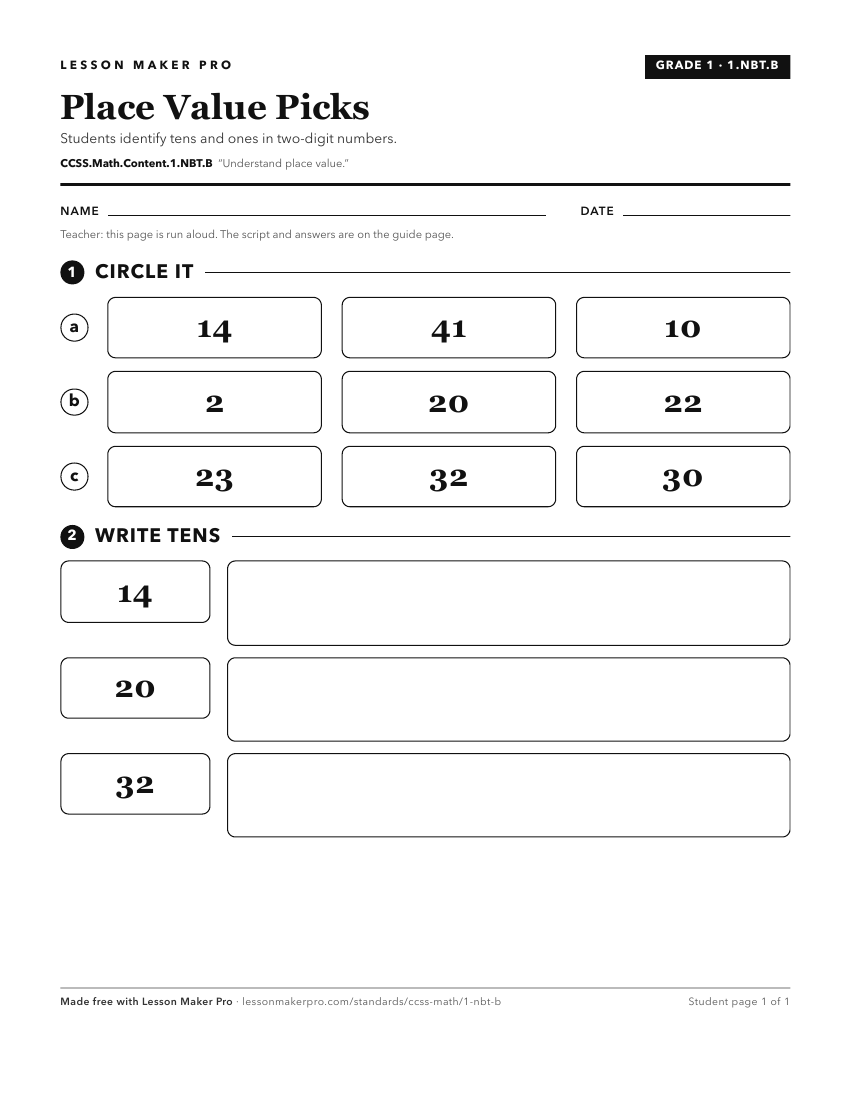
A ready-to-print activity worksheet aligned to CCSS.Math.Content.1.NBT.B, with an answer key for the teacher on its own page. No account needed.
PDF, US Letter, prints cleanly in black and white.
Download the worksheetKeep exploring
Related Standards
- CCSS.Math.Content.2.NBT.A
The 2nd Grade version of this standard.
- CCSS.Math.Content.4.NBT.A
Generalize place value understanding for multi-digit whole numbers.
- CCSS.Math.Content.5.NBT.A
Understand the place value system.
- CCSS.Math.Content.3.NBT.A
Use place value understanding and properties of operations to perform multi-digit arithmetic.
Turn this cluster into a lesson
Grade, subject, topic, and the complete cluster are prefilled. Create one free, no account needed.
Also for this cluster:Make a WorksheetMake a QuizMake a Sub Lesson