CCSS.
The Standard
Use words, phrases, and clauses as well as varied syntax to link the major sections of the text, create cohesion, and clarify the relationships between claim(s) and reasons, between reasons and evidence, and between claim(s) and counterclaims.
Common Core State Standards for English Language Arts
Teacher's field guide
What This Standard Means
What Students Need to Do
- Students connect each part of an argument so readers can follow the logic. They use precise linking language and varied sentence patterns to show how claims, reasons, evidence, and opposing views relate.
What Mastery Looks Like
- A student can guide the reader from a claim through reasons, evidence, and opposing views without abrupt jumps. The student chooses accurate transitions and varies sentence structure to show contrast, cause, example, and response.
Common Misconceptions
- Students often add transitions that sound formal but do not show the right relationship. They may repeat the same sentence pattern or drop evidence into a paragraph without explaining it. Some treat a counterclaim as a separate point rather than connecting it to their response.
How to Assess It
- Exit ticket: Turn these notes into one cohesive paragraph: “Claim: school should start later. Reason: teens need sleep. Evidence: adolescents need eight to ten hours. Counterclaim: sports may end later.” Use three clear links and at least two sentence patterns.
Lesson moves
Ways to Teach It
Print an argument in separate sections, then have pairs arrange and tape them together using transition cards that explain each connection.
Ask students to explain in writing how one reason supports a claim and how one counterclaim changes their response.
Run a transition swap: students replace repeated connectors in a paragraph, then vote on which revision makes the logic clearest.
Analyze a newspaper opinion column, highlighting language that connects claims, evidence, and opposing views before students imitate one paragraph.
Free download
Printable WHST.11-12.1c Worksheet
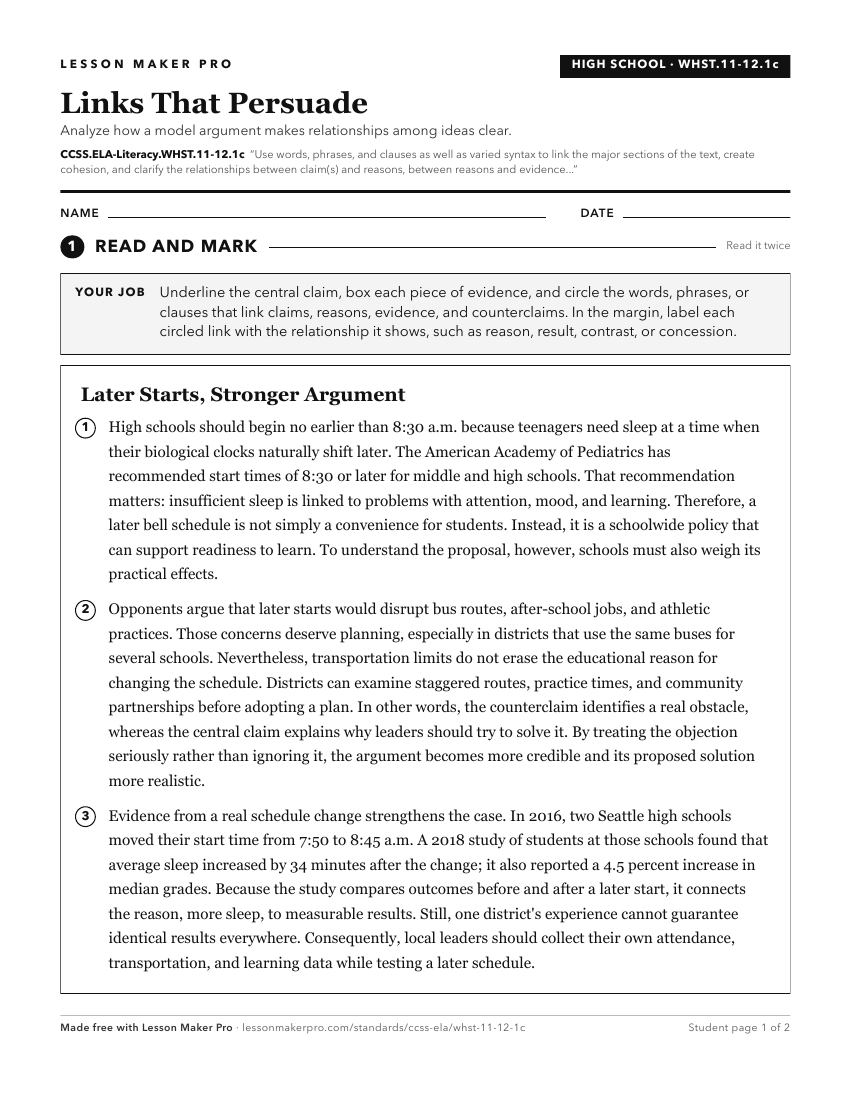
A ready-to-print activity worksheet aligned to CCSS.ELA-Literacy.WHST.11-12.1c, with an answer key for the teacher on its own page. No account needed.
PDF, US Letter, prints cleanly in black and white.
Download the worksheetLearning progression
Where This Standard Sits
Before This Standard
If students are struggling here, check these first.
Keep exploring
Related Standards
- CCSS.ELA-Literacy.W.9-10.1c
Use words, phrases, and clauses to link the major sections of the text, create cohesion, and clarify the relationships between claim(s) and reasons, between rea...
- CCSS.ELA-Literacy.W.11-12.1c
The Grades 11–12 version of this standard.
- CCSS.ELA-Literacy.WHST.6-8.1c
Use words, phrases, and clauses to create cohesion and clarify the relationships among claim(s), counterclaims, reasons, and evidence.
Turn this exact standard into a lesson
Grade, subject, topic, and the complete standard are prefilled. Create one free, no account needed.
Also for this standard:Make a WorksheetMake a QuizMake a Sub Lesson