CCSS.
The Standard
Use words, phrases, and clauses as well as varied syntax to link the major sections of the text, create cohesion, and clarify the relationships between claim(s) and reasons, between reasons and evidence, and between claim(s) and counterclaims.
Common Core State Standards for English Language Arts
Teacher's field guide
What This Standard Means
What Students Need to Do
- Students build an argument whose parts connect in a clear logical order. They use precise transitions and varied sentences to show support, evidence, qualification, or response to an objection.
What Mastery Looks Like
- A strong student guides the reader from claim to reason, evidence, counterclaim, and rebuttal without abrupt jumps. The student chooses precise connectors and changes sentence structure so the logic is clear, not merely smooth.
Common Misconceptions
- Students often insert connectors such as "however" or "therefore" without checking whether the logic fits. They may link nearby sentences but leave whole sections disconnected. Repetitive sentence openings can also blur the difference between evidence and commentary.
How to Assess It
- Exit ticket: Give students a six-sentence argument with two blank transitions. Ask them to fill both blanks and label the relationship each choice shows.
Lesson moves
Ways to Teach It
Give groups a cut-up argument; students arrange the paragraphs, then add transition strips explaining how each reason, example, and rebuttal connects.
Compare two paragraph versions and write which transition better shows the relationship between the claim and evidence, with one supporting reason.
Play Transition Swap: pairs replace weak connectors on argument cards, read both versions aloud, and earn points for clearer logical links.
Analyze an editorial or product review, highlighting phrases that connect its main claim, supporting reasons, evidence, and response to objections.
Free download
Printable W.11-12.1c Worksheet
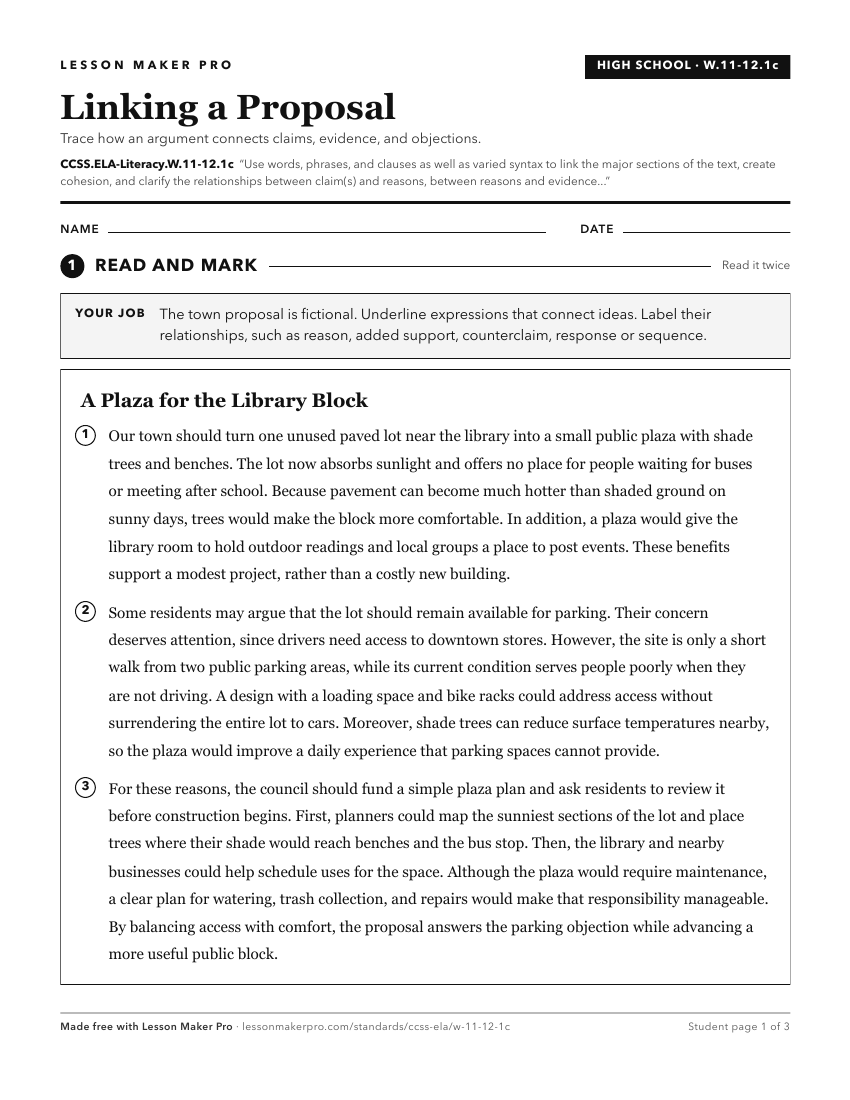
A ready-to-print activity worksheet aligned to CCSS.ELA-Literacy.W.11-12.1c, with an answer key for the teacher on its own page. No account needed.
PDF, US Letter, prints cleanly in black and white.
Download the worksheetLearning progression
Where This Standard Sits
Before This Standard
If students are struggling here, check these first.
Keep exploring
Related Standards
- CCSS.ELA-Literacy.WHST.9-10.1c
Use words, phrases, and clauses to link the major sections of the text, create cohesion, and clarify the relationships between claim(s) and reasons, between rea...
- CCSS.ELA-Literacy.WHST.11-12.1c
The Grades 11–12 version of this standard.
- CCSS.ELA-Literacy.WHST.6-8.1c
Use words, phrases, and clauses to create cohesion and clarify the relationships among claim(s), counterclaims, reasons, and evidence.
Turn this exact standard into a lesson
Grade, subject, topic, and the complete standard are prefilled. Create one free, no account needed.
Also for this standard:Make a WorksheetMake a QuizMake a Sub Lesson