CCSS.
The Standard
Introduce precise claim(s), distinguish the claim(s) from alternate or opposing claims, and create an organization that establishes clear relationships among claim(s), counterclaims, reasons, and evidence.
Common Core State Standards for English Language Arts
Teacher's field guide
What This Standard Means
What Students Need to Do
- Students state a focused, arguable position early in an argument. They name a competing position and arrange reasons, evidence, and responses so readers can follow the logic.
What Mastery Looks Like
- Students make their position and the competing view easy to tell apart. Each paragraph has a clear job, and transitions show how evidence supports a reason or answers a counterargument.
Common Misconceptions
- Students often write a fact or broad topic instead of an arguable claim. They may confuse a counterclaim with their own position, list evidence without linking it to reasons, or bury the claim late.
How to Assess It
- Exit ticket: Respond to “Should high schools limit student phone use during class?” Write one claim, one counterclaim, two reasons, and their logical order.
Lesson moves
Ways to Teach It
Give pairs color-coded sentence strips with a claim, counterclaim, reasons, and evidence, then have them arrange and defend a logical order.
Ask, “Should homework be capped at 30 minutes nightly?” Students write a claim, then accurately summarize the strongest opposing view.
Run a sorting relay where teams label cards as claim, counterclaim, reason, or evidence, then build the clearest argument map.
Compare two local newspaper opinion pieces, marking where each writer states a position, addresses opposition, and sequences supporting points.
Free download
Printable W.9-10.1a Worksheet
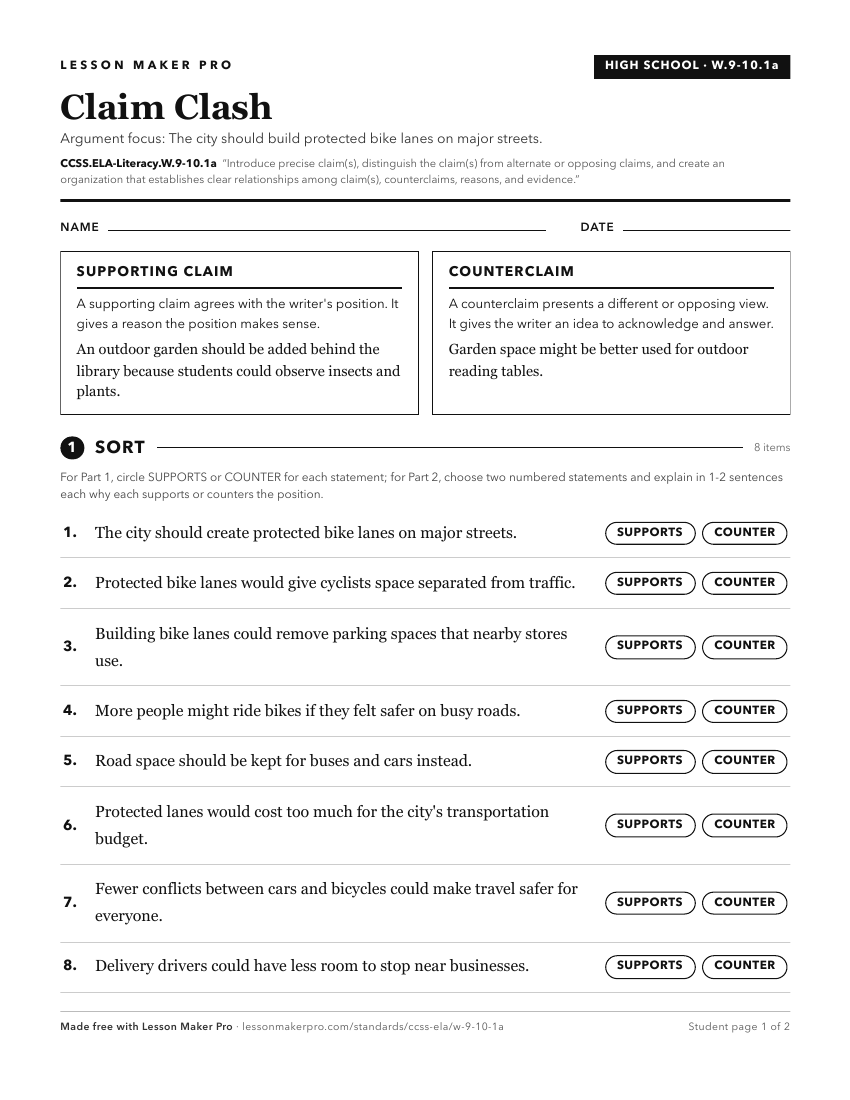
A ready-to-print activity worksheet aligned to CCSS.ELA-Literacy.W.9-10.1a, with an answer key for the teacher on its own page. No account needed.
PDF, US Letter, prints cleanly in black and white.
Download the worksheetLearning progression
Where This Standard Sits
Before This Standard
If students are struggling here, check these first.
What This Unlocks
Mastery here sets students up for these next.
Keep exploring
Related Standards
- CCSS.ELA-Literacy.WHST.9-10.1a
Introduce precise claim(s), distinguish the claim(s) from alternate or opposing claims, and create an organization that establishes clear relationships among th...
- CCSS.ELA-Literacy.WHST.11-12.1a
Introduce precise, knowledgeable claim(s), establish the significance of the claim(s), distinguish the claim(s) from alternate or opposing claims, and create an...
Turn this exact standard into a lesson
Grade, subject, topic, and the complete standard are prefilled. Create one free, no account needed.
Also for this standard:Make a WorksheetMake a QuizMake a Sub Lesson