CCSS.
The Standard
Introduce precise, knowledgeable claim(s), establish the significance of the claim(s), distinguish the claim(s) from alternate or opposing claims, and create an organization that logically sequences claim(s), counterclaims, reasons, and evidence.
Common Core State Standards for English Language Arts
Teacher's field guide
What This Standard Means
What Students Need to Do
- Students write a focused, informed position and show why the issue matters. They separate their view from competing views and arrange each part of the argument in a clear sequence.
What Mastery Looks Like
- The introduction makes the writer’s position, the stakes, and the main disagreement clear. Reasons, counterclaims, and evidence follow an order that a reader can easily track.
Common Misconceptions
- Students may offer a broad topic or fact instead of an arguable position. They may blur their position with the opposing view, bury the counterclaim, or place evidence in an order that does not build the argument.
How to Assess It
- Exit ticket: Write a three-sentence opening on whether schools should limit student phone use. Include a clear position, why it matters, and one opposing view.
Lesson moves
Ways to Teach It
Give pairs color-coded claim, reason, counterclaim, and evidence cards, then ask them to arrange and defend a logical sequence.
Write two openings for the same issue, one neutral and one argumentative, then explain which better establishes the stakes.
Run an argument sorting race where teams label sentences as claim, counterclaim, reason, or evidence and build a coherent outline.
Choose a local editorial and map how the writer introduces the issue, marks opposing views, and orders supporting evidence.
Free download
Printable W.11-12.1a Worksheet
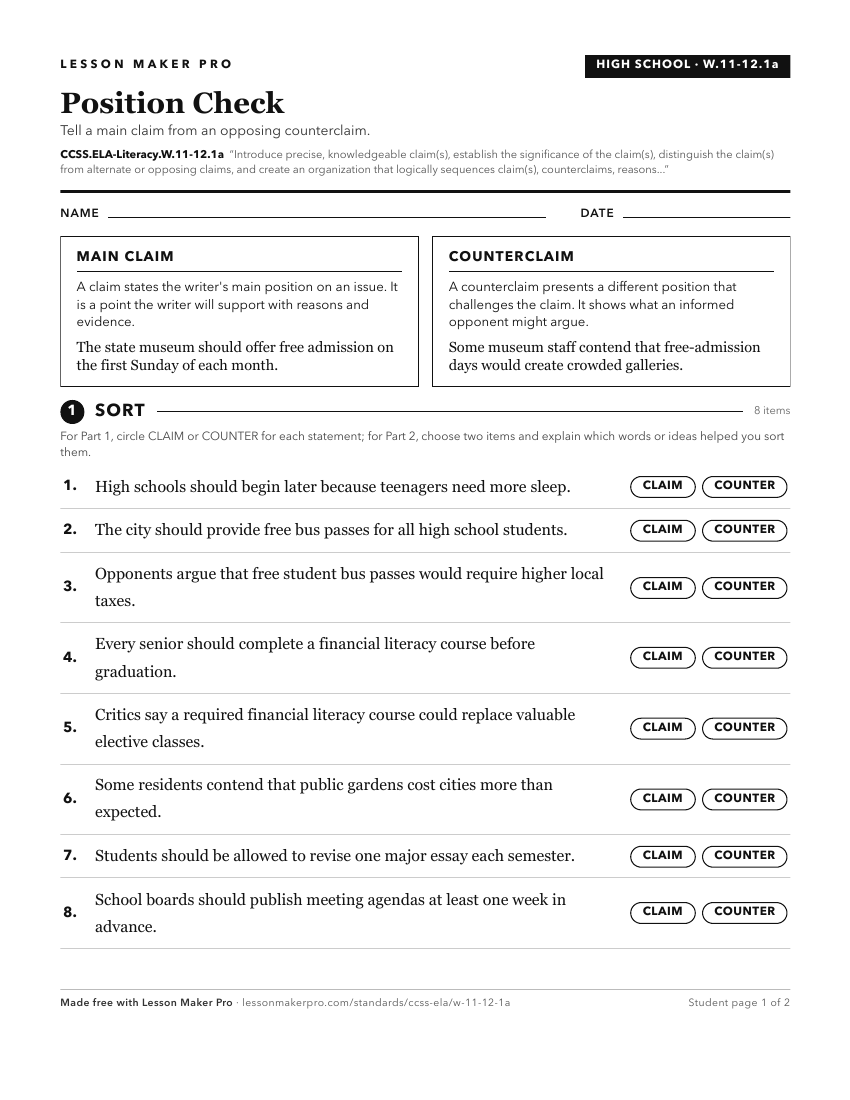
A ready-to-print activity worksheet aligned to CCSS.ELA-Literacy.W.11-12.1a, with an answer key for the teacher on its own page. No account needed.
PDF, US Letter, prints cleanly in black and white.
Download the worksheetLearning progression
Where This Standard Sits
Before This Standard
If students are struggling here, check these first.
Keep exploring
Related Standards
- CCSS.ELA-Literacy.WHST.9-10.1a
Introduce precise claim(s), distinguish the claim(s) from alternate or opposing claims, and create an organization that establishes clear relationships among th...
- CCSS.ELA-Literacy.W.8.1a
Introduce claim(s), acknowledge and distinguish the claim(s) from alternate or opposing claims, and organize the reasons and evidence logically.
- CCSS.ELA-Literacy.WHST.11-12.1a
Introduce precise, knowledgeable claim(s), establish the significance of the claim(s), distinguish the claim(s) from alternate or opposing claims, and create an...
Turn this exact standard into a lesson
Grade, subject, topic, and the complete standard are prefilled. Create one free, no account needed.
Also for this standard:Make a WorksheetMake a QuizMake a Sub Lesson