CCSS.
The Standard
Use a variety of transition words, phrases, and clauses to convey sequence, signal shifts from one time frame or setting to another, and show the relationships among experiences and events.
Common Core State Standards for English Language Arts
Teacher's field guide
What This Standard Means
What Students Need to Do
- Students connect events in a narrative so the reader can follow what happens and when. They choose varied transitions to mark changes in time or place and clarify how events relate.
What Mastery Looks Like
- A reader can follow the timeline and recognize changes in time or place without becoming confused. The student uses varied transitions that accurately connect actions, reactions, causes, and results.
Common Misconceptions
- Students often repeat "then" or "suddenly" instead of choosing precise transitions. They may use a transition that conflicts with the timeline or assume a paragraph break clearly shows a change in time or place.
How to Assess It
- Exit ticket: Write six sentences about missing a bus. Use four different transitions to show order, a change in place, and a connection between events.
Lesson moves
Ways to Teach It
Give teams a scrambled narrative on sentence strips; students order it and add transition cards for time, place, and event relationships.
Have students compare two versions of a scene, then explain which transitions make the timeline and setting changes clearer.
Play Transition Swap: students replace repeated uses of "then" in a paragraph, earning points only when the meaning stays accurate.
Students write an account of changing classes, using transitions to mark location changes, overlapping actions, and cause and effect.
Free download
Printable W.8.3c Worksheet
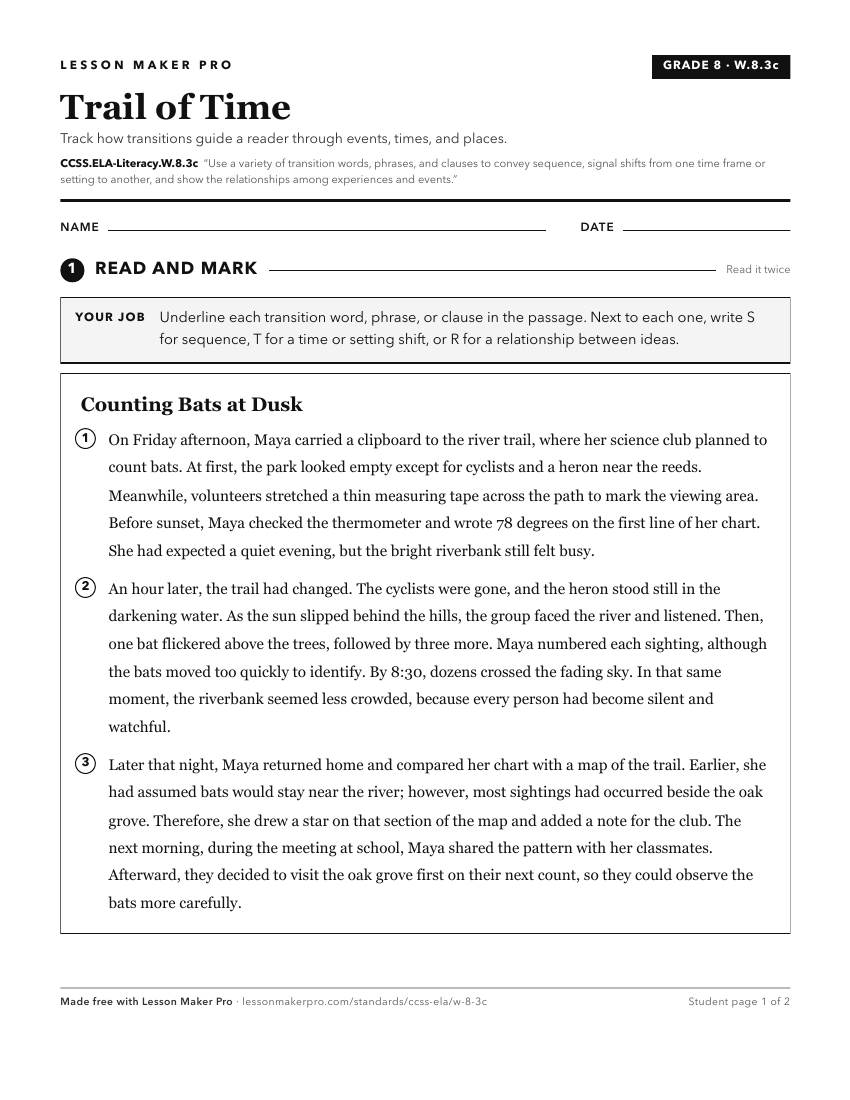
A ready-to-print activity worksheet aligned to CCSS.ELA-Literacy.W.8.3c, with an answer key for the teacher on its own page. No account needed.
PDF, US Letter, prints cleanly in black and white.
Download the worksheetLearning progression
Where This Standard Sits
Before This Standard
If students are struggling here, check these first.
What This Unlocks
Mastery here sets students up for these next.
Keep exploring
Related Standards
- CCSS.ELA-Literacy.W.4.3c
Use a variety of transitional words and phrases to manage the sequence of events.
- CCSS.ELA-Literacy.W.6.3c
Use a variety of transition words, phrases, and clauses to convey sequence and signal shifts from one time frame or setting to another.
- CCSS.ELA-Literacy.W.5.3c
Use a variety of transitional words, phrases, and clauses to manage the sequence of events.
Turn this exact standard into a lesson
Grade, subject, topic, and the complete standard are prefilled. Create one free, no account needed.
Also for this standard:Make a WorksheetMake a QuizMake a Sub Lesson