CCSS.
The Standard
- CCSS.ELA-Literacy.W.6.3
- Write narratives to develop real or imagined experiences or events using effective technique, relevant descriptive details, and well-structured event sequences.
Use a variety of transition words, phrases, and clauses to convey sequence and signal shifts from one time frame or setting to another.
Common Core State Standards for English Language Arts
Teacher's field guide
What This Standard Means
What Students Need to Do
- Students connect narrative events so readers can follow the order. They choose varied transitions that clearly mark changes in time or place.
What Mastery Looks Like
- Students use words, phrases, and clauses such as “later,” “after lunch,” and “when the rain stopped” accurately. Their narratives move smoothly between events, times, and places.
Common Misconceptions
- Students may repeat “then” or “next” for every event. They may choose transitions that do not match the event order. Some shift time or place without giving readers a clear signal.
How to Assess It
- Exit ticket: Write four narrative sentences using three varied transitions. Include one transition that marks a time shift and one that marks a setting shift.
Adopted as
This framework is adopted as written in Connecticut, Delaware, District of Columbia, Michigan, Nevada, New Hampshire, Vermont, Wyoming.
- California: W_6_3c
- Connecticut: CCSS.ELA-Literacy.W.6.3c
- Delaware: CC6W3c
- District of Columbia: CCSS.ELA-Literacy.W.6.3c
- Maryland: W_6_3_c
- Michigan: CCSS.ELA-Literacy.W.6.3c
- Montana: CCSS.ELA-Literacy.W.6.3c
- Nevada: CCSS.ELA-Literacy.W.6.3c
- New Hampshire: CCSS.ELA-Literacy.W.6.3c
- New Mexico: CCSS.ELA-Literacy.W.6.3c
- New York: 6W3.c
State teaching guidance: Across grade 6 writing, teach planning, revision and strengthening of texts independently and collaboratively, for varied purposes using print and digital tools. Students should move between conversational and academic registers and master some academic conventions, while improving keyboarding speed and accuracy. (Grade guidance, p. 75.) Use this component with the complete New York 6W3 requirement and its other components. A matching component does not establish equivalence of the entire national family. (NY component, p. 76.) New York State Next Generation English Language Arts Learning Standards (2017), page 75. Check shared national resources against this guidance before use.
- South Dakota: 6_W_3_c
- Vermont: CCSS.ELA-Literacy.W.6.3c
- Washington: CCSS.ELA-Literacy.W.6.3c
- Wyoming: CCSS.ELA-Literacy.W.6.3c
Lesson moves
Ways to Teach It
Give pairs six shuffled story sentence strips; students order them and add transition cards showing time or setting changes.
Ask, “How does ‘Hours later, across town’ guide a reader differently from ‘then’?” Students explain in two sentences.
Play Transition Swap: students replace repeated “then” words in a short narrative, earning points for accurate, varied choices.
Examine transitions in a sports recap, then write a recap that moves clearly between game moments and locations.
Free download
Printable W.6.3c Worksheet
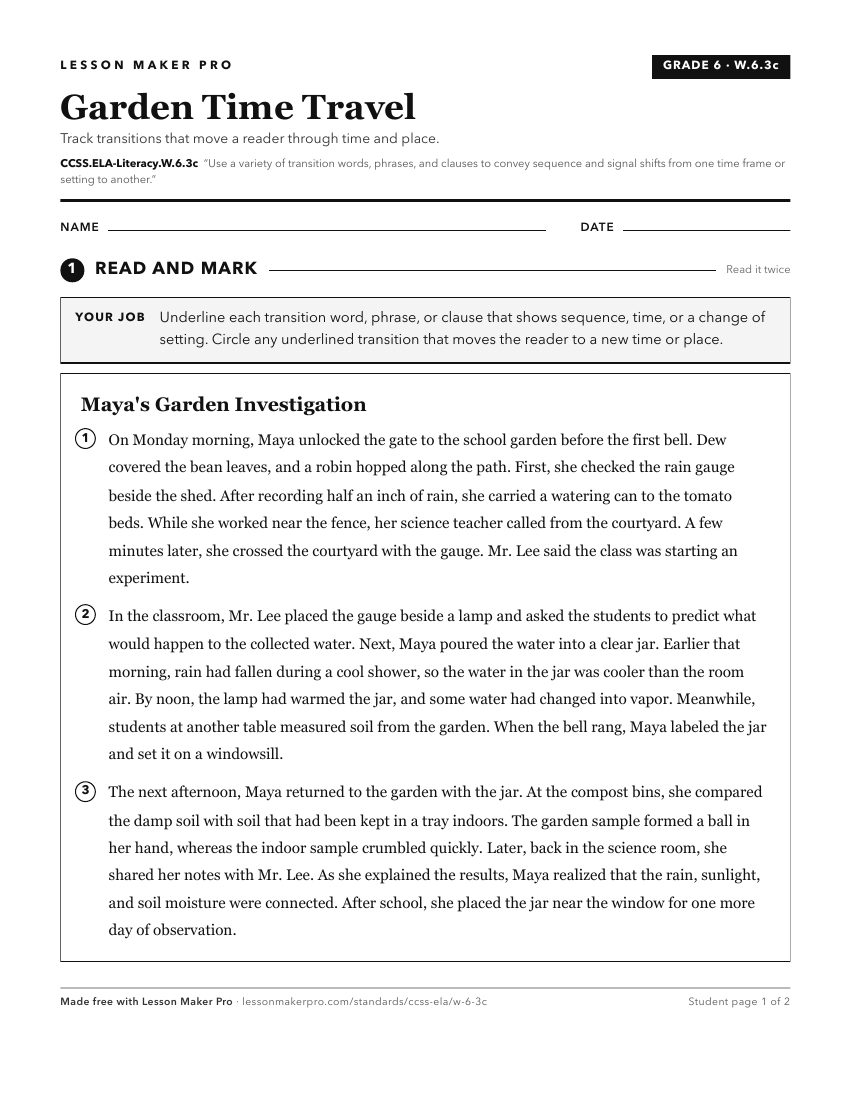
A ready-to-print activity worksheet aligned to CCSS.ELA-Literacy.W.6.3c, with an answer key for the teacher on its own page. No account needed.
PDF, US Letter, prints cleanly in black and white.
Download the worksheetLearning progression
Where This Standard Sits
Before This Standard
If students are struggling here, check these first.
What This Unlocks
Mastery here sets students up for these next.
Keep exploring
Related Standards
Turn this exact standard into a lesson
Grade, subject, topic, and the complete standard are prefilled. Create one free, no account needed.
Also for this standard:Make a WorksheetMake a QuizMake a Sub Lesson