CCSS.
The Standard
Provide a sense of closure.
Common Core State Standards for English Language Arts
Teacher's field guide
What This Standard Means
What Students Need to Do
- Students write an ending that connects to the characters, problem, and events. They show what happens afterward or how a character responds, rather than stopping suddenly.
What Mastery Looks Like
- The student writes an ending that follows naturally from the story’s events and makes the narrative feel finished. The ending may show a final action, feeling, lesson, or change.
Common Misconceptions
- Students may think writing “The End” is enough. They may stop after the main event, add an unrelated surprise, or introduce a new problem instead of wrapping up the story.
How to Assess It
- Give students a short narrative with the ending removed. Ask, “Write two or three sentences that show what happens after the problem is solved.”
Lesson moves
Ways to Teach It
Give groups mixed story cards and three possible endings, then have them choose and explain which ending fits best.
Read two endings for the same story and ask students to write which one feels more complete and why.
Play Ending Match by pairing short story openings and problems with ending cards that resolve the events.
Examine the final pages of familiar picture books and list how each author shows what changed for the character.
Free download
Printable W.3.3d Worksheet
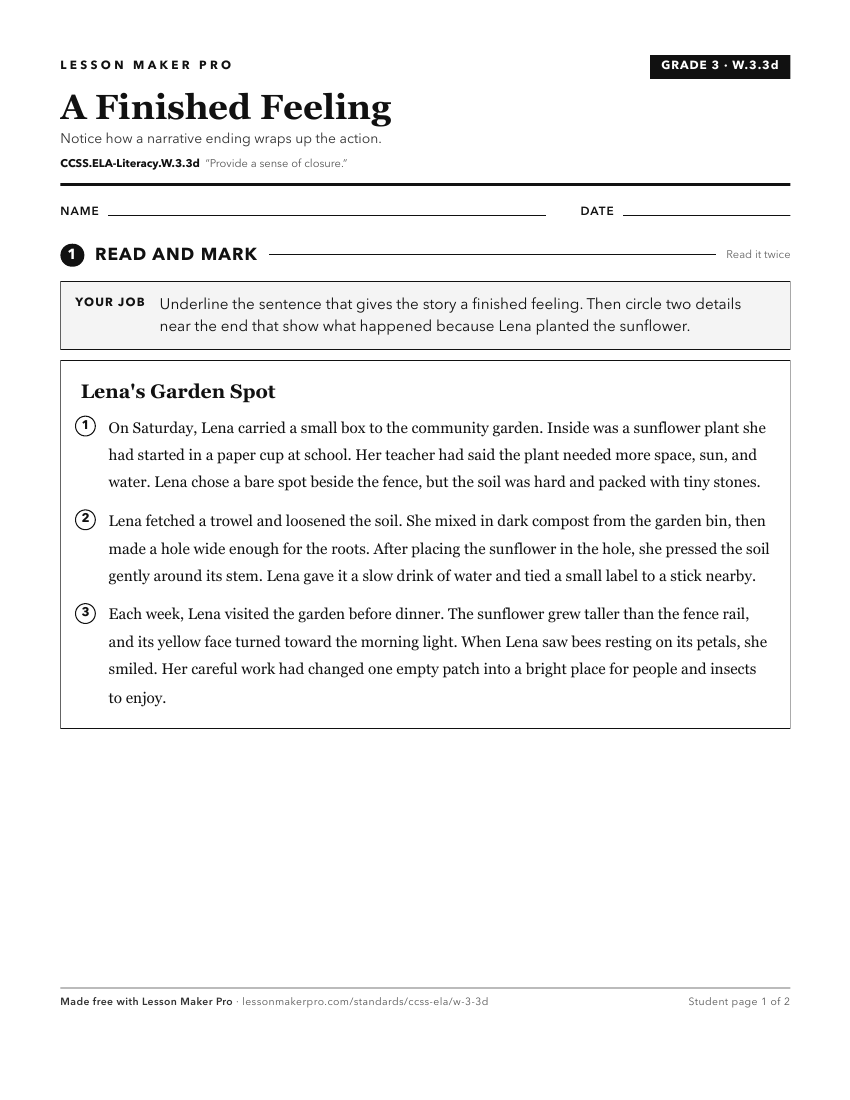
A ready-to-print activity worksheet aligned to CCSS.ELA-Literacy.W.3.3d, with an answer key for the teacher on its own page. No account needed.
PDF, US Letter, prints cleanly in black and white.
Download the worksheetKeep exploring
Related Standards
- CCSS.ELA-Literacy.W.3.1d
Provide a concluding statement or section.
- CCSS.ELA-Literacy.W.5.1d
Provide a concluding statement or section related to the opinion presented.
- CCSS.ELA-Literacy.W.3.2d
Provide a concluding statement or section.
- CCSS.ELA-Literacy.W.4.1d
Provide a concluding statement or section related to the opinion presented.
Turn this exact standard into a lesson
Grade, subject, topic, and the complete standard are prefilled. Create one free, no account needed.
Also for this standard:Make a WorksheetMake a QuizMake a Sub Lesson