CCSS.
The Standard
Use temporal words and phrases to signal event order.
Common Core State Standards for English Language Arts
Teacher's field guide
What This Standard Means
What Students Need to Do
- Students choose words and phrases such as "first," "later," "meanwhile," and "finally" to guide readers through a narrative. They place these transitions where events or timing change.
What Mastery Looks Like
- A student can write a narrative whose sequence is easy to follow. The student uses several accurate transitions and places them where the time or event changes.
Common Misconceptions
- Students may add "then" before every event instead of choosing varied transitions. They may also use words such as "meanwhile," "before," or "after" when the timing does not fit.
How to Assess It
- Exit ticket: Put four scrambled story events in order, then connect them using at least three different time-order words or phrases.
Lesson moves
Ways to Teach It
Give pairs story events on sentence strips to arrange, then have them add transition cards between each event.
Ask students to explain how changing "later" to "meanwhile" affects the timing in a short paragraph.
Play Transition Match by having students pair event sentences with fitting words such as "first," "afterward," and "finally."
Have students write their morning routine using five time-order words, then check whether each word matches the actual sequence.
Free download
Printable W.3.3c Worksheet
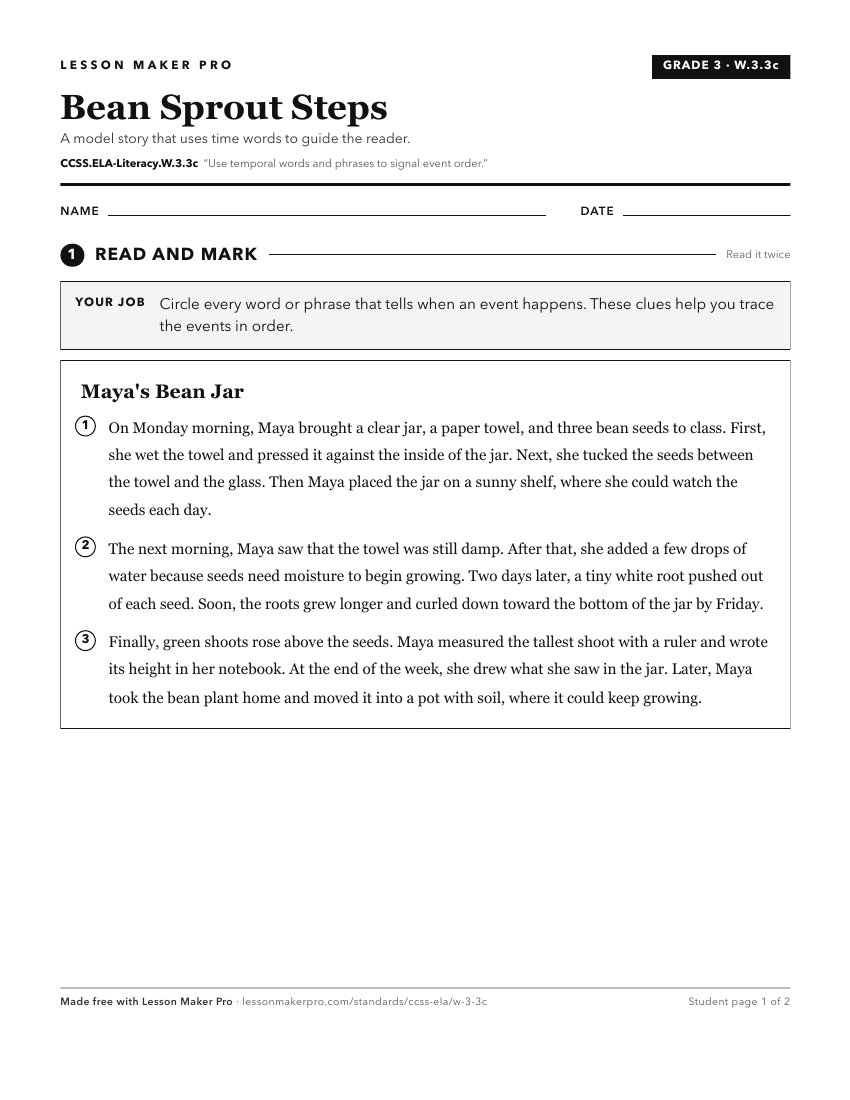
A ready-to-print activity worksheet aligned to CCSS.ELA-Literacy.W.3.3c, with an answer key for the teacher on its own page. No account needed.
PDF, US Letter, prints cleanly in black and white.
Download the worksheetLearning progression
Where This Standard Sits
What This Unlocks
Mastery here sets students up for these next.
Keep exploring
Related Standards
- CCSS.ELA-Literacy.W.7.3c
Use a variety of transition words, phrases, and clauses to convey sequence and signal shifts from one time frame or setting to another.
- CCSS.ELA-Literacy.W.6.3c
Use a variety of transition words, phrases, and clauses to convey sequence and signal shifts from one time frame or setting to another.
- CCSS.ELA-Literacy.W.5.3c
Use a variety of transitional words, phrases, and clauses to manage the sequence of events.
Turn this exact standard into a lesson
Grade, subject, topic, and the complete standard are prefilled. Create one free, no account needed.
Also for this standard:Make a WorksheetMake a QuizMake a Sub Lesson