CCSS.
The Standard
Provide a conclusion that follows from and reflects on what is experienced, observed, or resolved over the course of the narrative.
Common Core State Standards for English Language Arts
Teacher's field guide
What This Standard Means
What Students Need to Do
- Students craft a narrative ending that logically follows the events, observations, and conflict developed earlier. They also reflect on how the experience affected the narrator or characters.
What Mastery Looks Like
- Students write an ending that grows naturally from earlier events and addresses the central conflict or change. The conclusion shows what the experience means without explaining the message too bluntly.
Common Misconceptions
- Students may add a sudden twist, new conflict, or unrelated lesson instead of resolving the established narrative. They may simply repeat earlier events without showing what the narrator now understands.
How to Assess It
- Give students a short narrative with the final paragraph removed. Ask them to write a three-sentence ending that resolves the conflict and shows the narrator’s reflection.
Lesson moves
Ways to Teach It
Give groups event cards from a short narrative, then have them arrange the cards and draft an ending that fits the sequence.
Ask students to write: What has the narrator learned, and which earlier detail best supports that reflection?
Play Ending Match by pairing short narratives with possible conclusions, then require students to defend each match using textual evidence.
Use a college essay excerpt and revise its final paragraph to connect a specific experience with the writer’s changed perspective.
Free download
Printable W.11-12.3e Worksheet
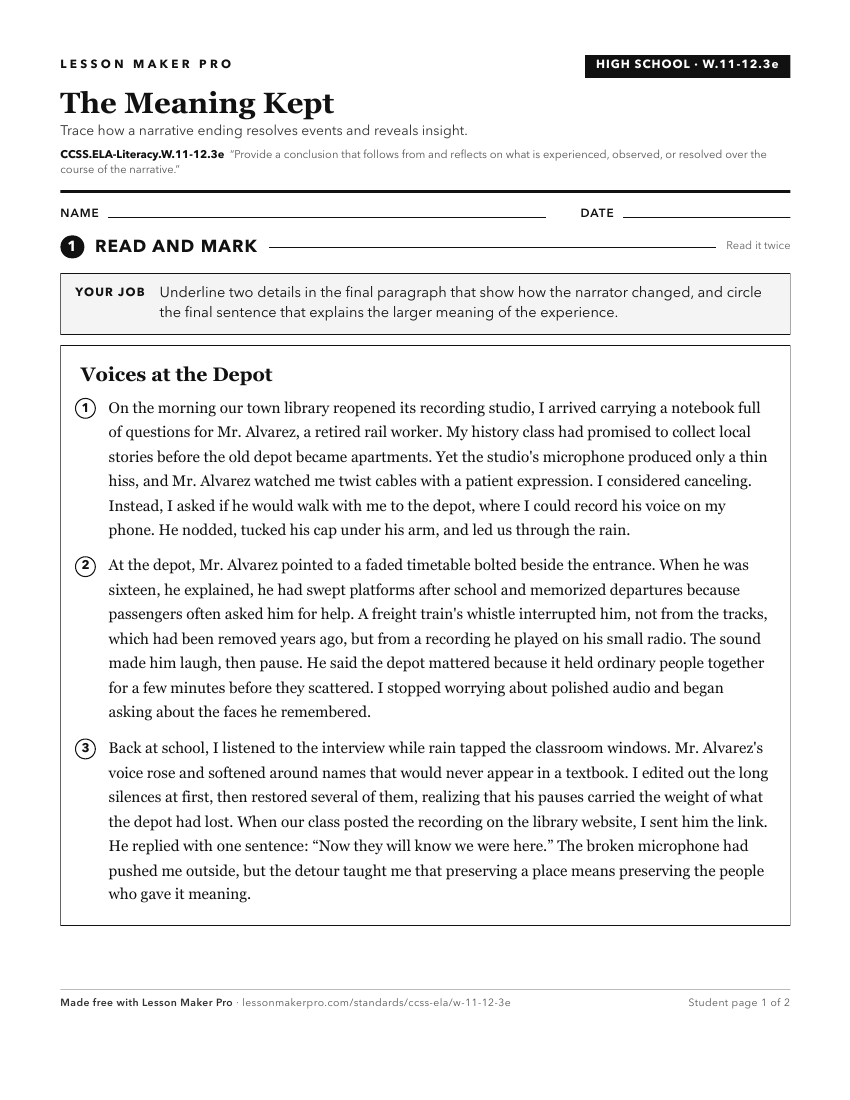
A ready-to-print activity worksheet aligned to CCSS.ELA-Literacy.W.11-12.3e, with an answer key for the teacher on its own page. No account needed.
PDF, US Letter, prints cleanly in black and white.
Download the worksheetLearning progression
Where This Standard Sits
Before This Standard
If students are struggling here, check these first.
Keep exploring
Related Standards
- CCSS.ELA-Literacy.W.4.3e
Provide a conclusion that follows from the narrated experiences or events.
- CCSS.ELA-Literacy.W.7.3e
Provide a conclusion that follows from and reflects on the narrated experiences or events.
- CCSS.ELA-Literacy.W.8.3e
Provide a conclusion that follows from and reflects on the narrated experiences or events.
Turn this exact standard into a lesson
Grade, subject, topic, and the complete standard are prefilled. Create one free, no account needed.
Also for this standard:Make a WorksheetMake a QuizMake a Sub Lesson