CCSS.
The Standard
Delineate a speaker's argument and specific claims, distinguishing claims that are supported by reasons and evidence from claims that are not.
Common Core State Standards for English Language Arts · Speaking and Listening Standards
Teacher's field guide
What This Standard Means
What Students Need to Do
- Students listen closely to a speaker and identify the main position and separate claims. They match each claim with its reasons and evidence, then flag claims without support.
What Mastery Looks Like
- Students can complete a listening chart with the speaker’s position, claims, reasons, and evidence. They can point out unsupported claims and explain what support is missing.
Common Misconceptions
- Students may treat a speaker’s opinion, confidence, or repetition as evidence. They may confuse reasons with evidence or accept facts that do not actually support the claim.
How to Assess It
- Play a one-minute speech with one supported claim and one unsupported claim. Ask students to name both claims and list the reason or evidence for each.
Lesson moves
Ways to Teach It
Give groups claim, reason, and evidence cards from a short speech to connect, then place unsupported claims in a separate column.
After listening to a speech, students write which claim is strongest and quote the speaker’s reason or evidence.
Play Supported or Not by reading claims aloud while students hold up S or U cards and justify each choice.
Compare two student council campaign clips and chart which promises have facts or examples behind them and which do not.
Free download
Printable SL.6.3 Worksheet
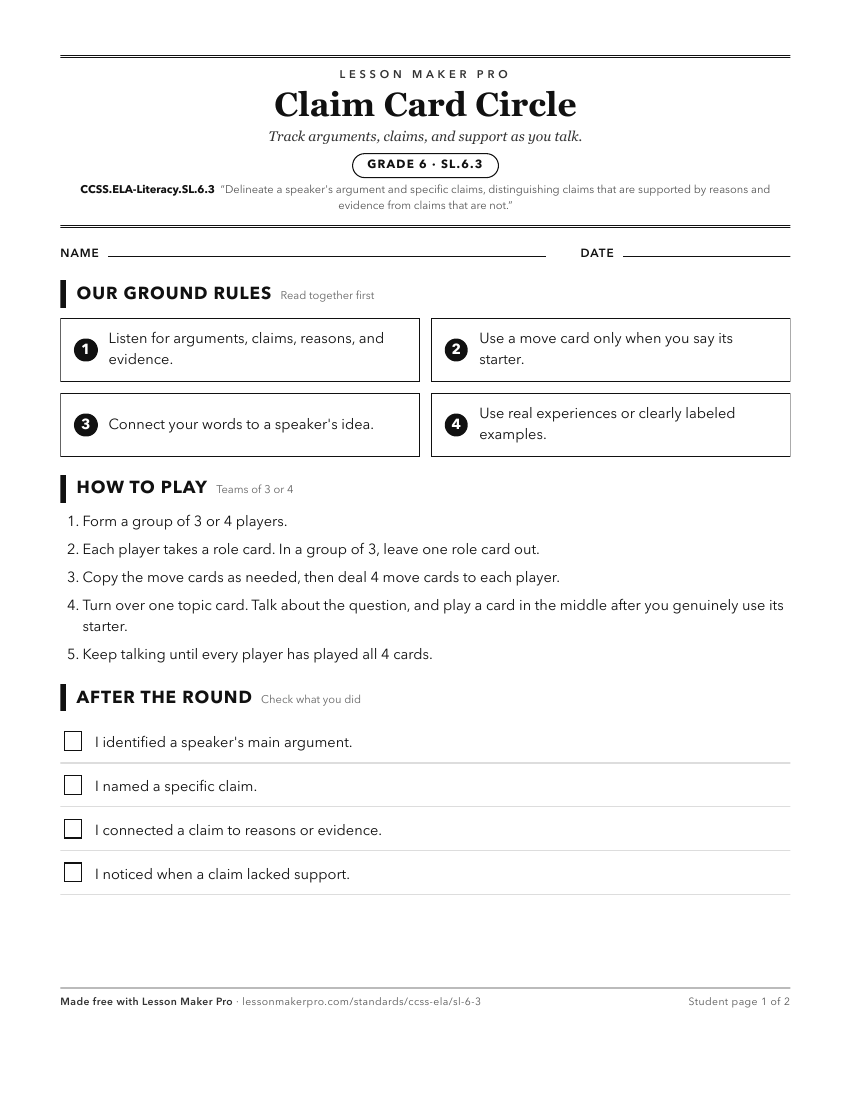
A ready-to-print activity worksheet aligned to CCSS.ELA-Literacy.SL.6.3, with an answer key for the teacher on its own page. No account needed.
PDF, US Letter, prints cleanly in black and white.
Download the worksheetLearning progression
Where This Standard Sits
See the whole path on the Speaking & Listening progression map.
Before This Standard
If students are struggling here, check these first.
What This Unlocks
Mastery here sets students up for these next.
Keep exploring
Related Standards
- CCSS.ELA-Literacy.SL.4.3
Identify the reasons and evidence a speaker provides to support particular points.
- CCSS.ELA-Literacy.CCRA.R.8
Delineate and evaluate the argument and specific claims in a text, including the validity of the reasoning as well as the relevance and sufficiency of the evide...
- CCSS.ELA-Literacy.SL.8.3
Delineate a speaker's argument and specific claims, evaluating the soundness of the reasoning and relevance and sufficiency of the evidence and identifying when...
Turn this exact standard into a lesson
Grade, subject, topic, and the complete standard are prefilled. Create one free, no account needed.
Also for this standard:Make a WorksheetMake a QuizMake a Sub Lesson