CCSS.
The Standard
Identify the reasons and evidence a speaker provides to support particular points.
Common Core State Standards for English Language Arts · Speaking and Listening Standards
Teacher's field guide
What This Standard Means
What Students Need to Do
- Students listen closely to a speaker and identify the main points being made. They name the reasons and evidence the speaker uses to support each point.
What Mastery Looks Like
- Students state a speaker’s point in their own words. They identify the reasons and evidence used, then explain how each one supports the point.
Common Misconceptions
- Students may list facts they heard without connecting them to the speaker’s point. They may also confuse a personal opinion with evidence or assume every detail supports the main claim.
How to Assess It
- Read a one-minute argument aloud. Ask students to write the speaker’s main point, one reason, and one piece of evidence that supports that reason.
Lesson moves
Ways to Teach It
Play a short recorded argument, then have students sort note cards labeled point, reason, and evidence into matching groups.
Ask, “Which reason best supports the speaker’s point, and what evidence makes it strong?” Students answer in three sentences.
Give teams a claim and mixed reason-and-evidence cards, then award points for building accurate support chains.
Listen to a school announcement proposing a change, then identify the point, reasons, and evidence offered by the speaker.
Free download
Printable SL.4.3 Worksheet
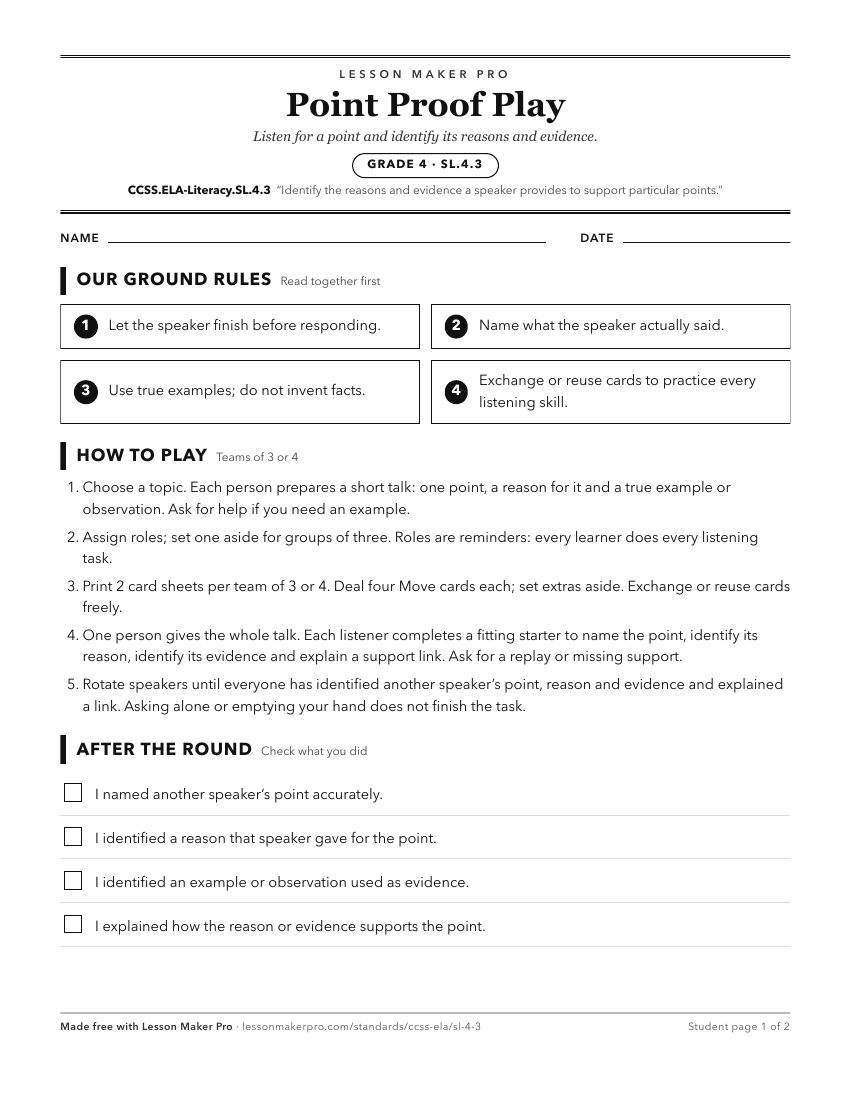
A ready-to-print activity worksheet aligned to CCSS.ELA-Literacy.SL.4.3, with an answer key for the teacher on its own page. No account needed.
PDF, US Letter, prints cleanly in black and white.
Download the worksheetLearning progression
Where This Standard Sits
See the whole path on the Speaking & Listening progression map.
Before This Standard
If students are struggling here, check these first.
What This Unlocks
Mastery here sets students up for these next.
Keep exploring
Related Standards
- CCSS.ELA-Literacy.RI.1.8
Identify the reasons an author gives to support points in a text.
- CCSS.ELA-Literacy.RI.5.8
Explain how an author uses reasons and evidence to support particular points in a text, identifying which reasons and evidence support which point(s).
- CCSS.ELA-Literacy.RI.4.8
Explain how an author uses reasons and evidence to support particular points in a text.
Turn this exact standard into a lesson
Grade, subject, topic, and the complete standard are prefilled. Create one free, no account needed.
Also for this standard:Make a WorksheetMake a QuizMake a Sub Lesson