CCSS.
The Standard
Analyze how complex characters (e.g., those with multiple or conflicting motivations) develop over the course of a text, interact with other characters, and advance the plot or develop the theme.
Common Core State Standards for English Language Arts · Reading Standards for Literature
Teacher's field guide
What This Standard Means
What Students Need to Do
- Students track what a character wants, including motives that clash or change. They explain how the character’s choices and relationships cause later events and shape a theme, using details from across the text.
What Mastery Looks Like
- A student can select scenes from the beginning, middle, and end to show how a character changes. The student clearly links motives, choices, relationships, plot events, and a theme.
Common Misconceptions
- Students often label a character with one trait and treat it as fixed. They may retell events without explaining cause, or state a theme without connecting it to the character’s choices and relationships.
How to Assess It
- Exit ticket: Choose one character from today’s reading. In four sentences, name two competing motives, cite one choice, and explain how it affects a relationship and later event.
Lesson moves
Ways to Teach It
Give pairs character, motive, and event cards from a shared story, then have them arrange a cause-and-effect chain and defend each link.
Ask students to write: Which conflicting desire most shapes the protagonist’s choices, and what scene best proves it?
Play Motivation Match: teams match quoted actions to possible motives, then earn a point by explaining the strongest textual clue.
Have students analyze a school scenario where loyalty conflicts with honesty, then predict how each choice could affect relationships and outcomes.
Free download
Printable RL.9-10.3 Worksheet
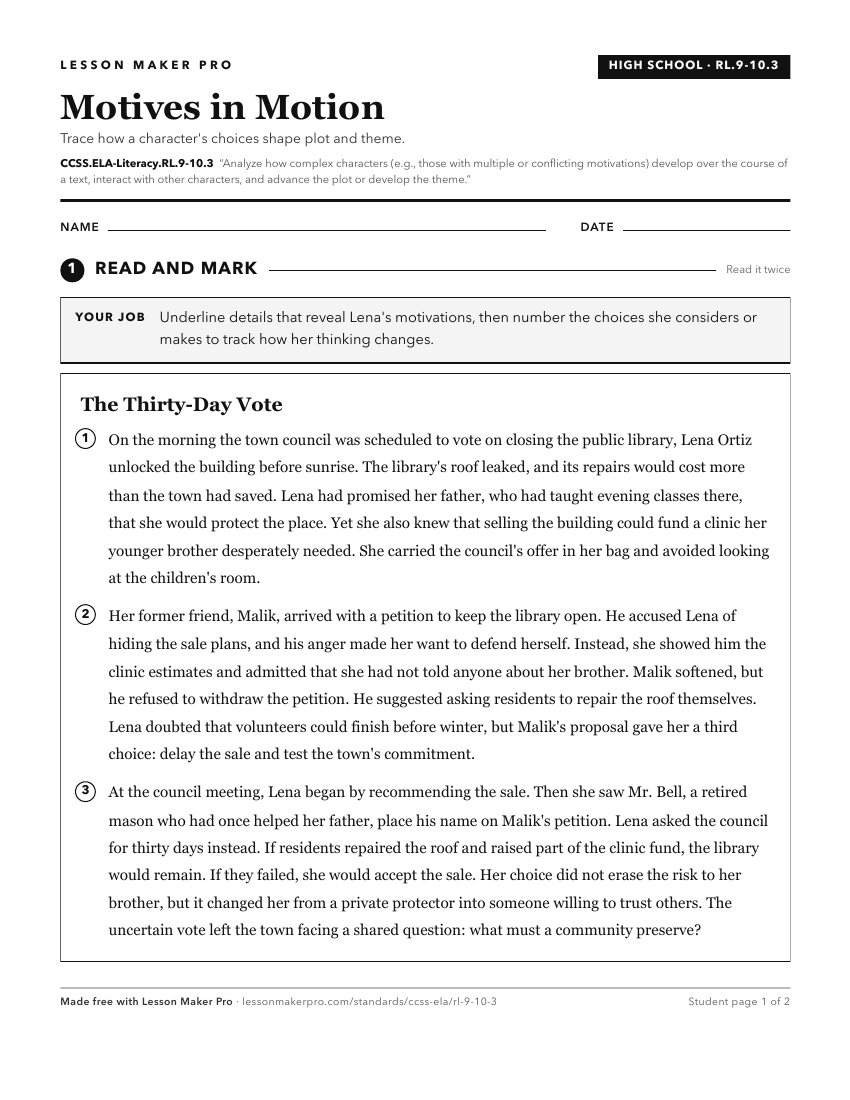
A ready-to-print activity worksheet aligned to CCSS.ELA-Literacy.RL.9-10.3, with an answer key for the teacher on its own page. No account needed.
PDF, US Letter, prints cleanly in black and white.
Download the worksheetLearning progression
Where This Standard Sits
See the whole path on the Reading: Literature progression map.
Before This Standard
If students are struggling here, check these first.
What This Unlocks
Mastery here sets students up for these next.
Keep exploring
Related Standards
- CCSS.ELA-Literacy.RL.7.6
Analyze how an author develops and contrasts the points of view of different characters or narrators in a text.
- CCSS.ELA-Literacy.RI.11-12.3
Analyze a complex set of ideas or sequence of events and explain how specific individuals, ideas, or events interact and develop over the course of the text.
- CCSS.ELA-Literacy.RL.7.3
Analyze how particular elements of a story or drama interact (e.g., how setting shapes the characters or plot).
- CCSS.ELA-Literacy.CCRA.R.3
Analyze how and why individuals, events, and ideas develop and interact over the course of a text.
Turn this exact standard into a lesson
Grade, subject, topic, and the complete standard are prefilled. Create one free, no account needed.
Also for this standard:Make a WorksheetMake a QuizMake a Sub Lesson