CCSS.
The Standard
Analyze how a drama's or poem's form or structure (e.g., soliloquy, sonnet) contributes to its meaning.
Common Core State Standards for English Language Arts · Reading Standards for Literature
Teacher's field guide
What This Standard Means
What Students Need to Do
- Students identify choices such as stanza breaks, rhyme patterns, repetition, scene divisions, and soliloquies. They explain how those choices shape meaning, mood, pacing, or character understanding.
What Mastery Looks Like
- Students accurately name a structural choice and connect it to a shift in mood, idea, pacing, or character insight. They support the connection with specific lines or stage details.
Common Misconceptions
- Students may name rhyme, stanza breaks, or a soliloquy without explaining its effect. They may confuse form with topic or claim a choice adds interest without citing details.
How to Assess It
- Give students a short poem with a clear stanza break. Ask: How does the break change the speaker’s idea or feeling? Cite one detail.
Lesson moves
Ways to Teach It
Cut a poem into lines and stanzas, then have pairs arrange it and explain how their structure changes meaning.
Read a soliloquy aloud, then write: What does the audience learn that other characters do not?
Play Structure and Effect Match using cards labeled rhyme, repetition, scene break, monologue, suspense, emphasis, contrast, and reflection.
Compare a song’s verse and chorus, then explain how repetition highlights its main message.
Free download
Printable RL.7.5 Worksheet
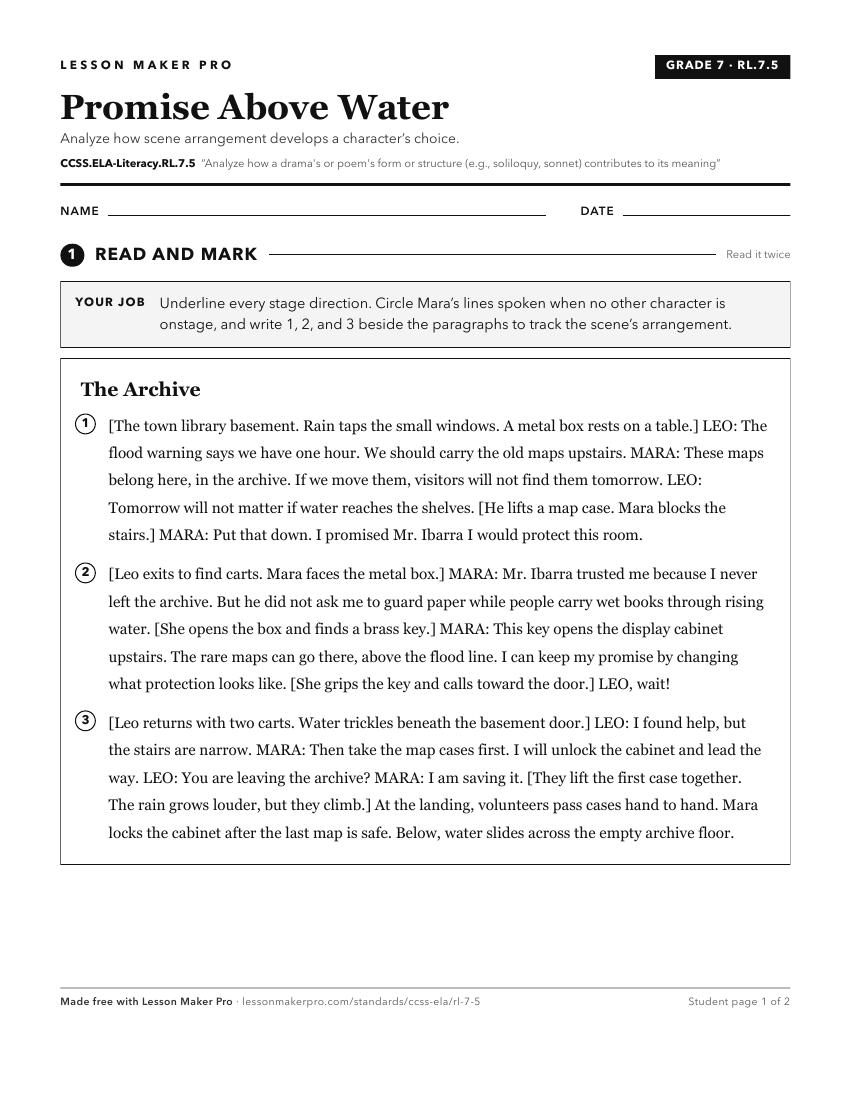
A ready-to-print activity worksheet aligned to CCSS.ELA-Literacy.RL.7.5, with an answer key for the teacher on its own page. No account needed.
PDF, US Letter, prints cleanly in black and white.
Download the worksheetLearning progression
Where This Standard Sits
See the whole path on the Reading: Literature progression map.
Before This Standard
If students are struggling here, check these first.
What This Unlocks
Mastery here sets students up for these next.
Keep exploring
Related Standards
- CCSS.ELA-Literacy.RL.7.4
Determine the meaning of words and phrases as they are used in a text, including figurative and connotative meanings; analyze the impact of rhymes and other rep...
- CCSS.ELA-Literacy.RL.7.3
Analyze how particular elements of a story or drama interact (e.g., how setting shapes the characters or plot).
- CCSS.ELA-Literacy.RL.11-12.5
Analyze how an author's choices concerning how to structure specific parts of a text (e.g., the choice of where to begin or end a story, the choice to provide a...
Turn this exact standard into a lesson
Grade, subject, topic, and the complete standard are prefilled. Create one free, no account needed.
Also for this standard:Make a WorksheetMake a QuizMake a Sub Lesson