CCSS.
The Standard
Analyze how an author's choices concerning how to structure specific parts of a text (e.g., the choice of where to begin or end a story, the choice to provide a comedic or tragic resolution) contribute to its overall structure and meaning as well as its aesthetic impact.
Common Core State Standards for English Language Arts · Reading Standards for Literature
Teacher's field guide
What This Standard Means
What Students Need to Do
- Students examine how an author arranges parts of a literary work, including its opening, ending, scenes, and shifts in time or viewpoint. They explain how those choices shape meaning and the reader’s experience.
What Mastery Looks Like
- Students can point to a specific opening, ending, scene order, or shift and explain its role in the whole work. They support the explanation with details and describe effects such as suspense, irony, surprise, or closure.
Common Misconceptions
- Students often summarize events instead of analyzing why the author placed them in that order. They may label a flashback or tragic ending without explaining its effect on meaning, tension, or tone.
How to Assess It
- Exit ticket: Identify one structural choice in today’s reading, then explain how moving or removing that part would change the work’s meaning and emotional effect.
Lesson moves
Ways to Teach It
Give pairs a story opening cut into paragraph strips, then have them reorder it and compare their version with the author’s sequence.
Ask students to write: Why does the author begin here rather than earlier, and what does that choice make readers expect?
Play Structure Swap by assigning groups one scene to move, remove, or retell, then awarding points for the clearest effect analysis.
Compare a novel’s ending with its film adaptation, noting how each resolution changes the audience’s understanding and emotional response.
Free download
Printable RL.11-12.5 Worksheet
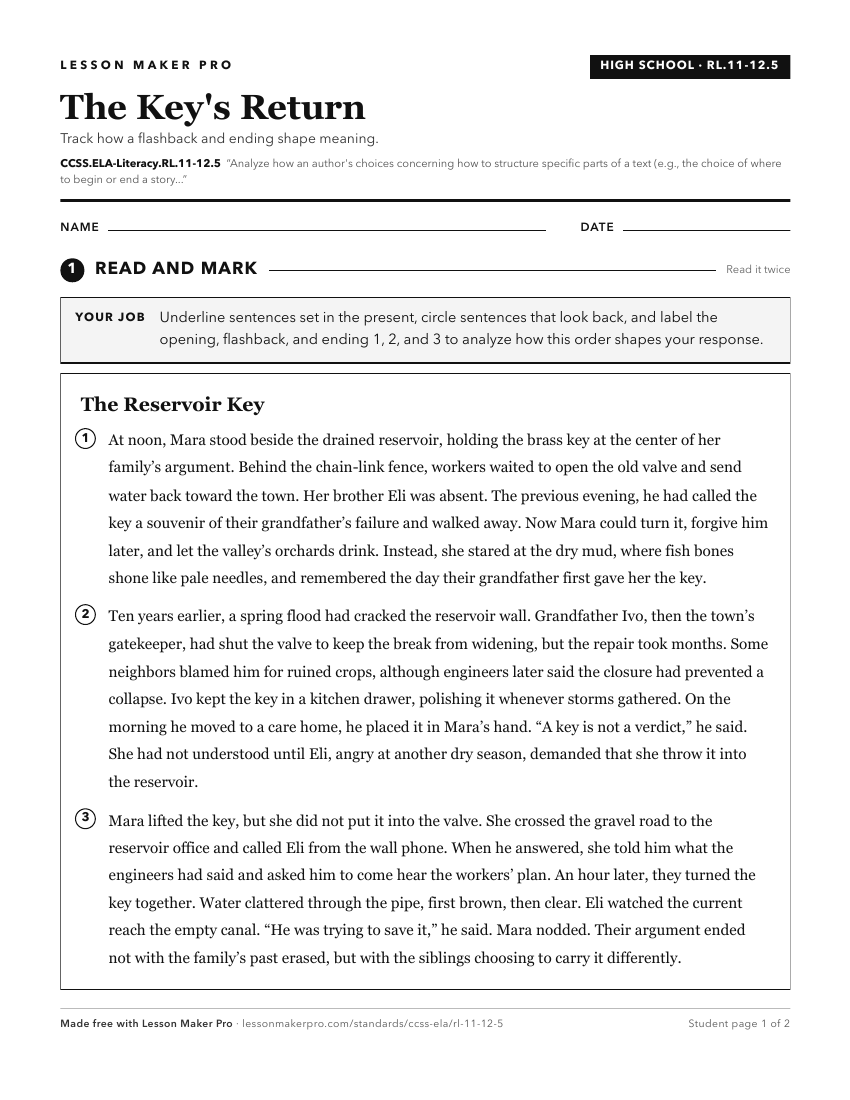
A ready-to-print activity worksheet aligned to CCSS.ELA-Literacy.RL.11-12.5, with an answer key for the teacher on its own page. No account needed.
PDF, US Letter, prints cleanly in black and white.
Download the worksheetLearning progression
Where This Standard Sits
See the whole path on the Reading: Literature progression map.
Before This Standard
If students are struggling here, check these first.
Keep exploring
Related Standards
- CCSS.ELA-Literacy.RI.7.5
Analyze the structure an author uses to organize a text, including how the major sections contribute to the whole and to the development of the ideas.
- CCSS.ELA-Literacy.RST.6-8.5
Analyze the structure an author uses to organize a text, including how the major sections contribute to the whole and to an understanding of the topic.
- CCSS.ELA-Literacy.RL.11-12.3
Analyze the impact of the author's choices regarding how to develop and relate elements of a story or drama (e.g., where a story is set, how the action is order...
Turn this exact standard into a lesson
Grade, subject, topic, and the complete standard are prefilled. Create one free, no account needed.
Also for this standard:Make a WorksheetMake a QuizMake a Sub Lesson