CCSS.
The Standard
Distinguish their own point of view from that of the narrator or those of the characters.
Common Core State Standards for English Language Arts · Reading Standards for Literature
Teacher's field guide
What This Standard Means
What Students Need to Do
- Students identify who is telling the story and explain what the narrator or a character thinks, feels, or believes. They compare that perspective with their own response to the same event.
What Mastery Looks Like
- A student can describe a narrator’s or character’s perspective using details from the text. The student can then explain clearly how that perspective matches or differs from their own.
Common Misconceptions
- Students may confuse the narrator with the author or assume every character shares the narrator’s view. They may also give their own opinion without explaining how it differs from a story figure’s perspective.
How to Assess It
- Exit ticket: Choose one story event and complete these sentences: “The narrator or character thinks ___ because ___.” “I think ___ because ___.”
Lesson moves
Ways to Teach It
Give pairs quote and reaction cards from a shared story to sort into three labeled columns: narrator, character, and me.
Ask students to write: “Which character do you disagree with, and what story detail explains that character’s thinking?”
Play Perspective Detective by reading clues aloud while teams identify whose viewpoint each clue reveals and cite the matching sentence.
Read a short recess disagreement, then have students explain each child’s view and state how they would respond.
Free download
Printable RL.3.6 Worksheet
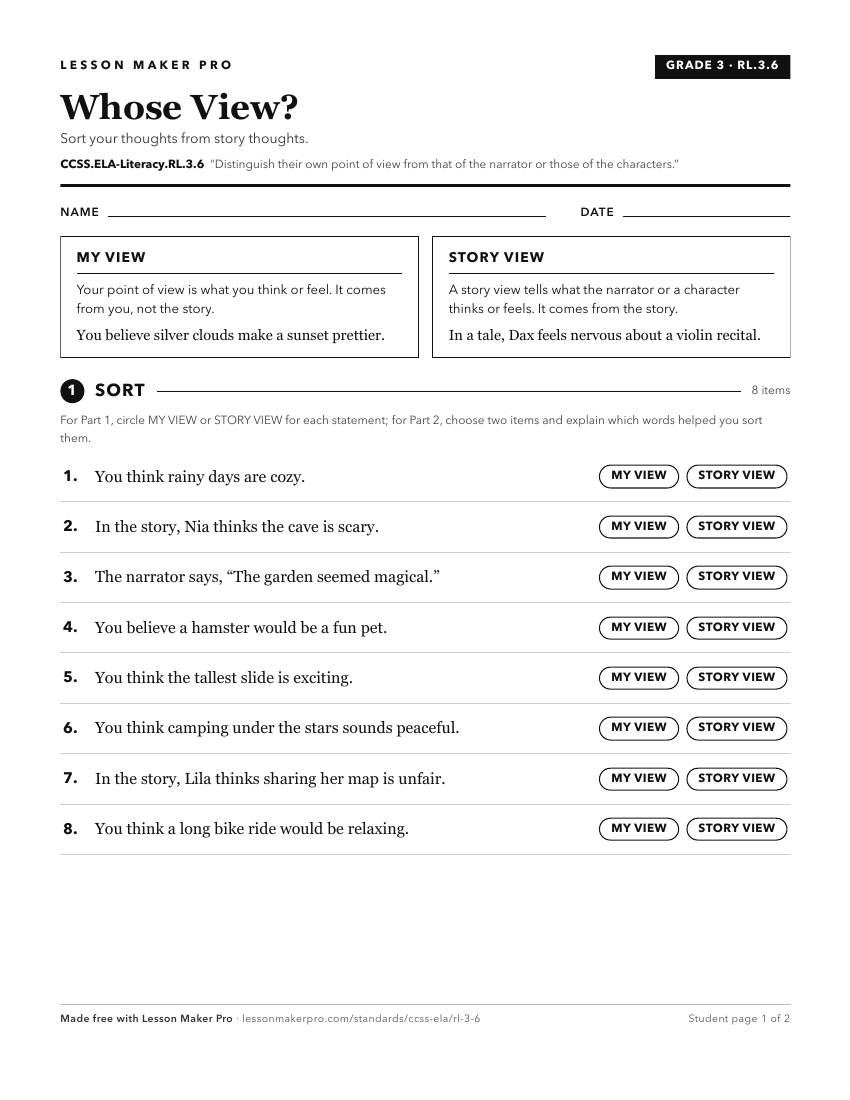
A ready-to-print activity worksheet aligned to CCSS.ELA-Literacy.RL.3.6, with an answer key for the teacher on its own page. No account needed.
PDF, US Letter, prints cleanly in black and white.
Download the worksheetLearning progression
Where This Standard Sits
See the whole path on the Reading: Literature progression map.
Before This Standard
If students are struggling here, check these first.
What This Unlocks
Mastery here sets students up for these next.
Keep exploring
Related Standards
- CCSS.ELA-Literacy.RL.7.6
Analyze how an author develops and contrasts the points of view of different characters or narrators in a text.
- CCSS.ELA-Literacy.RI.3.6
Distinguish their own point of view from that of the author of a text.
- CCSS.ELA-Literacy.RL.6.6
Explain how an author develops the point of view of the narrator or speaker in a text.
Turn this exact standard into a lesson
Grade, subject, topic, and the complete standard are prefilled. Create one free, no account needed.
Also for this standard:Make a WorksheetMake a QuizMake a Sub Lesson