CCSS.
The Standard
Use illustrations and details in a story to describe its characters, setting, or events.
Common Core State Standards for English Language Arts · Reading Standards for Literature
Teacher's field guide
What This Standard Means
What Students Need to Do
- Students look closely at pictures and listen to or read the words on the page. They use clues from both to tell about who, where, and what happened.
What Mastery Looks Like
- A student gives an accurate description of a character, setting, or event. The student points to a matching clue in the picture and a detail from the story.
Common Misconceptions
- Students may name what they see without explaining what it shows about the story. They may also guess from the picture while ignoring details in the words.
How to Assess It
- Show one page from a familiar story. Ask, “What does this page tell you about the character, setting, or event, and which clues helped you?”
Lesson moves
Ways to Teach It
Give pairs a story page, sticky notes, and crayons to label picture clues about the character, setting, and event.
After a read-aloud, ask, “What do the picture and words show us that we did not know before?”
Play Clue Match by having students pair story detail cards with matching illustration cards and explain each match.
Use a classroom photograph and caption to describe the people, place, and action from visible and written clues.
Free download
Printable RL.1.7 Worksheet
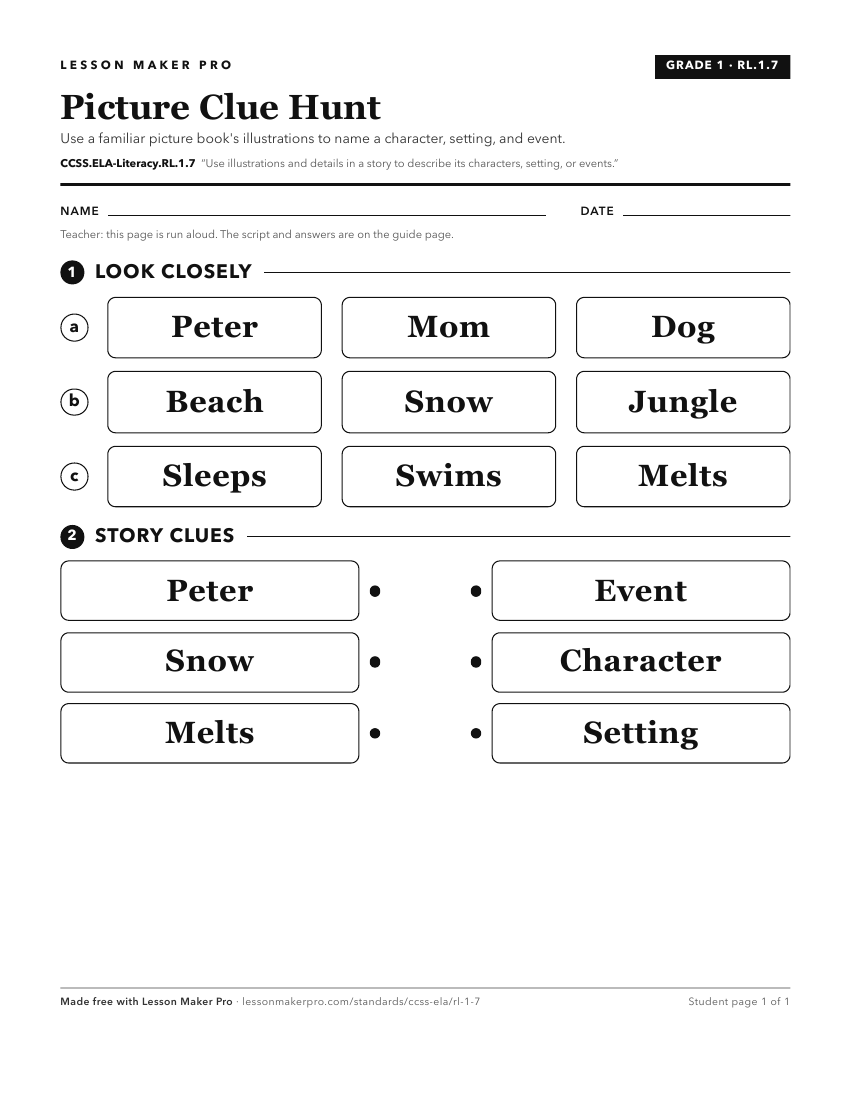
A ready-to-print activity worksheet aligned to CCSS.ELA-Literacy.RL.1.7, with an answer key for the teacher on its own page. No account needed.
PDF, US Letter, prints cleanly in black and white.
Download the worksheetLearning progression
Where This Standard Sits
See the whole path on the Reading: Literature progression map.
Before This Standard
If students are struggling here, check these first.
What This Unlocks
Mastery here sets students up for these next.
Keep exploring
Related Standards
- CCSS.ELA-Literacy.RL.1.3
Describe characters, settings, and major events in a story, using key details.
- CCSS.ELA-Literacy.RI.1.7
Use the illustrations and details in a text to describe its key ideas.
- CCSS.ELA-Literacy.RL.4.3
Describe in depth a character, setting, or event in a story or drama, drawing on specific details in the text (e.g., a character's thoughts, words, or actions).
Turn this exact standard into a lesson
Grade, subject, topic, and the complete standard are prefilled. Create one free, no account needed.
Also for this standard:Make a WorksheetMake a QuizMake a Sub Lesson