CCSS.
The Standard
Describe characters, settings, and major events in a story, using key details.
Common Core State Standards for English Language Arts · Reading Standards for Literature
Teacher's field guide
What This Standard Means
What Students Need to Do
- Students identify who the story is about, where and when it happens, and which actions matter most. They use words or pictures from the story to explain their answers.
What Mastery Looks Like
- Students can name the main characters, explain where the story takes place, and retell the most important events in order. They support each answer with a relevant detail from the words or pictures.
Common Misconceptions
- Students may list every small action instead of choosing events that shape the story. They may confuse the setting with a character’s feelings or give character traits without story evidence.
How to Assess It
- Give an exit ticket with three boxes labeled Who, Where, and Important Event. Students draw or write an answer in each box and add one supporting detail.
Lesson moves
Ways to Teach It
Give pairs picture and sentence cards to sort under Character, Setting, or Event headings, then ask them to explain one choice.
Ask, “Which character made the biggest choice, and what detail shows why the choice mattered?”
Play Story Detective by reading clues aloud while students hold up Character, Setting, or Event cards.
Compare the story’s setting with the classroom or neighborhood, then list two ways the places are alike or different.
Free download
Printable RL.1.3 Worksheet
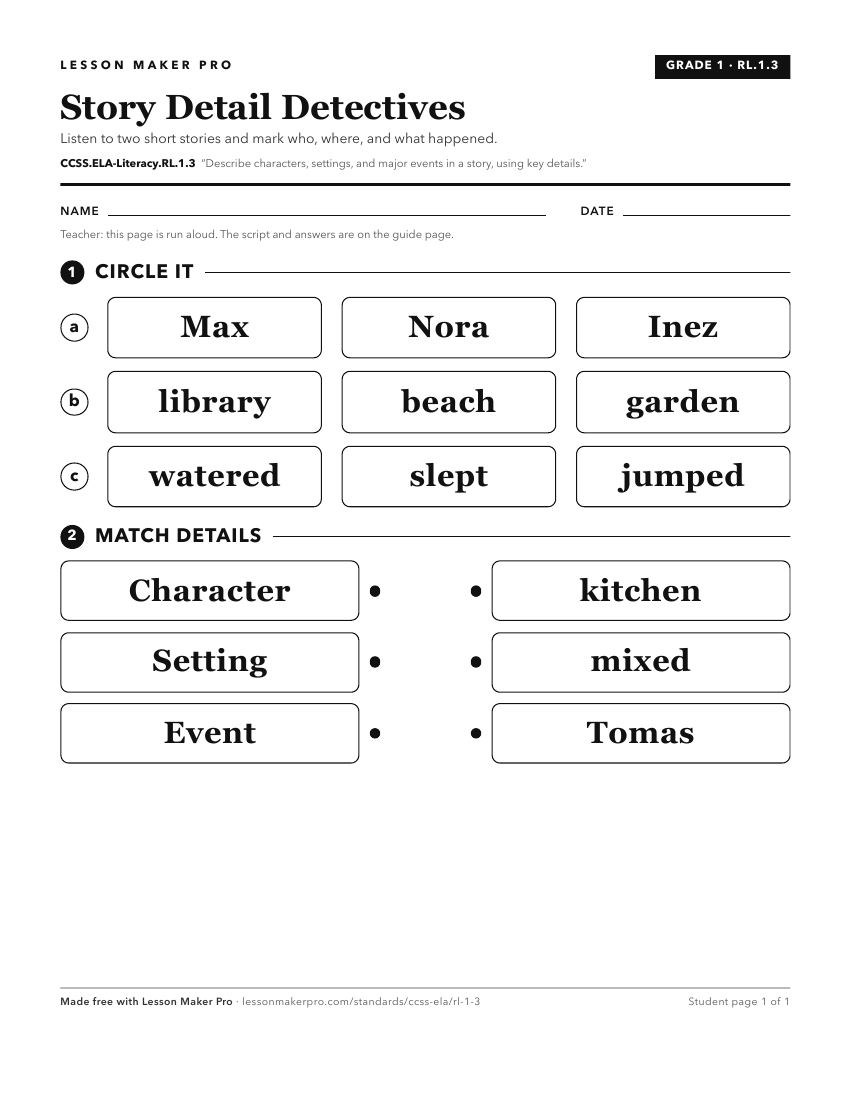
A ready-to-print activity worksheet aligned to CCSS.ELA-Literacy.RL.1.3, with an answer key for the teacher on its own page. No account needed.
PDF, US Letter, prints cleanly in black and white.
Download the worksheetLearning progression
Where This Standard Sits
See the whole path on the Reading: Literature progression map.
Before This Standard
If students are struggling here, check these first.
What This Unlocks
Mastery here sets students up for these next.
Keep exploring
Related Standards
- CCSS.ELA-Literacy.RL.1.7
Use illustrations and details in a story to describe its characters, setting, or events.
- CCSS.ELA-Literacy.RI.1.7
Use the illustrations and details in a text to describe its key ideas.
- CCSS.ELA-Literacy.RL.4.3
Describe in depth a character, setting, or event in a story or drama, drawing on specific details in the text (e.g., a character's thoughts, words, or actions).
Turn this exact standard into a lesson
Grade, subject, topic, and the complete standard are prefilled. Create one free, no account needed.
Also for this standard:Make a WorksheetMake a QuizMake a Sub Lesson