CCSS.
The Standard
Identify who is telling the story at various points in a text.
Common Core State Standards for English Language Arts · Reading Standards for Literature
Teacher's field guide
What This Standard Means
What Students Need to Do
- Students name the character or narrator whose voice tells each part of a story. They notice when the telling voice changes and use words or pictures as clues.
What Mastery Looks Like
- A student can stop at several places in a story and name whose voice is telling that part. They point to words, dialogue tags, or pictures that support each answer.
Common Misconceptions
- Students may name the author instead of the narrator or character telling the story. They may choose the character shown in the picture or confuse spoken dialogue with the storytelling voice.
How to Assess It
- Show: “I hid the red ball,” said Mia. Ben looked under the chair. Ask, “Who speaks first, and who tells what Ben does? Circle the clues.”
Lesson moves
Ways to Teach It
Give pairs character sticks and a short story, then have them hold up the character whose voice tells each marked part.
Read a page twice, then ask, “Whose voice do we hear here, and which words prove it?”
Play Narrator or Character by reading sentence cards and having students sort them into labeled corners of the room.
Have students recount a playground event from their view, then retell it as another person who was there.
Free download
Printable RL.1.6 Worksheet
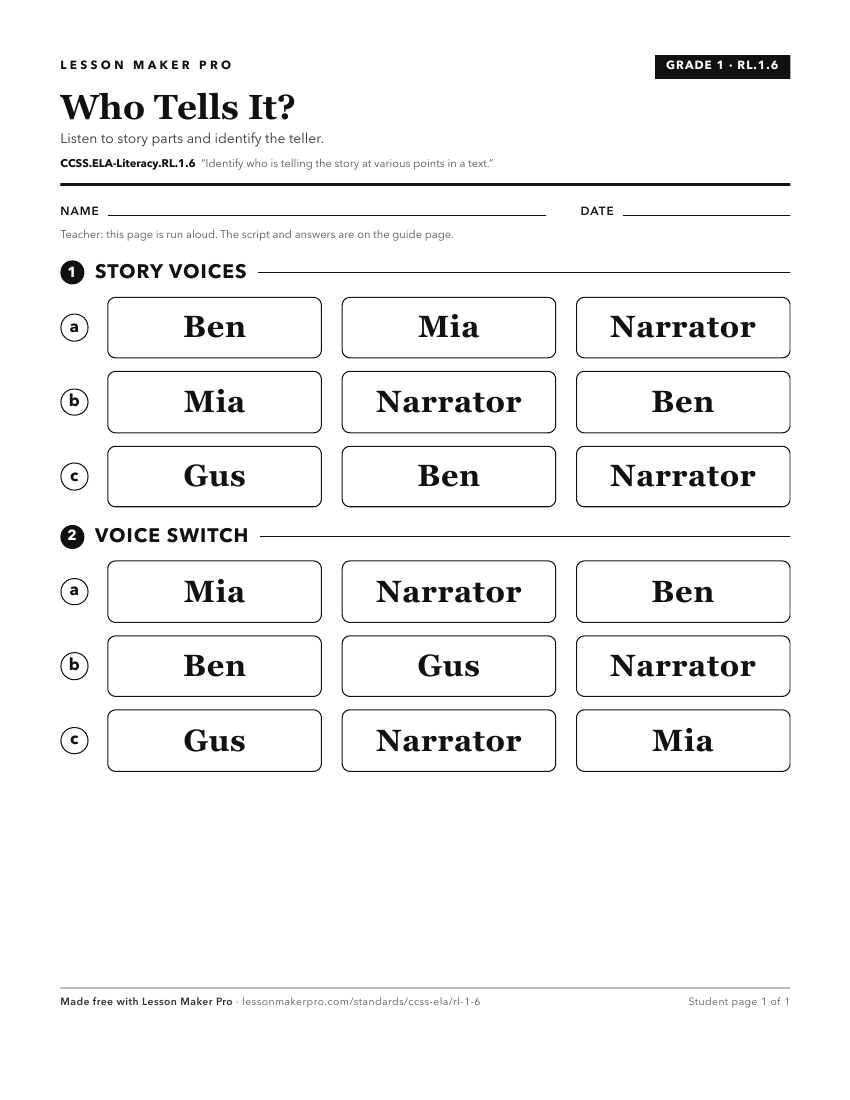
A ready-to-print activity worksheet aligned to CCSS.ELA-Literacy.RL.1.6, with an answer key for the teacher on its own page. No account needed.
PDF, US Letter, prints cleanly in black and white.
Download the worksheetLearning progression
Where This Standard Sits
See the whole path on the Reading: Literature progression map.
Before This Standard
If students are struggling here, check these first.
What This Unlocks
Mastery here sets students up for these next.
Keep exploring
Related Standards
- CCSS.ELA-Literacy.RL.7.6
Analyze how an author develops and contrasts the points of view of different characters or narrators in a text.
- CCSS.ELA-Literacy.RL.4.6
Compare and contrast the point of view from which different stories are narrated, including the difference between first- and third-person narrations.
- CCSS.ELA-Literacy.RL.K.3
With prompting and support, identify characters, settings, and major events in a story.
Turn this exact standard into a lesson
Grade, subject, topic, and the complete standard are prefilled. Create one free, no account needed.
Also for this standard:Make a WorksheetMake a QuizMake a Sub Lesson