CCSS.
The Standard
Use information gained from illustrations (e.g., maps, photographs) and the words in a text to demonstrate understanding of the text (e.g., where, when, why, and how key events occur).
Common Core State Standards for English Language Arts · Reading Standards for Informational Text
Teacher's field guide
What This Standard Means
What Students Need to Do
- Students gather information from written text and visuals such as maps, photographs, and diagrams. They combine those details to explain where, when, why, or how events occur.
What Mastery Looks Like
- Students identify useful details in both the text and its visuals. They combine those details to explain where, when, why, or how an event happened.
Common Misconceptions
- Students may treat photographs, maps, and diagrams as decoration instead of sources of information. They may use only the words or only the visual, or add details based on guesses rather than evidence.
How to Assess It
- Give students a short paragraph paired with a map or photograph. Ask, “Where did the event happen, and how do you know?” Require one detail from each source.
Lesson moves
Ways to Teach It
Cut apart a short article and its visuals, then have pairs match them and label one detail each visual adds.
Show a photograph with a paragraph and ask students to write how each source helps explain what happened.
Play Evidence Match by having teams pair text detail cards with map, photograph, or diagram detail cards.
Read a local event notice with a map, then have students explain where the event occurs and how visitors should arrive.
Free download
Printable RI.3.7 Worksheet
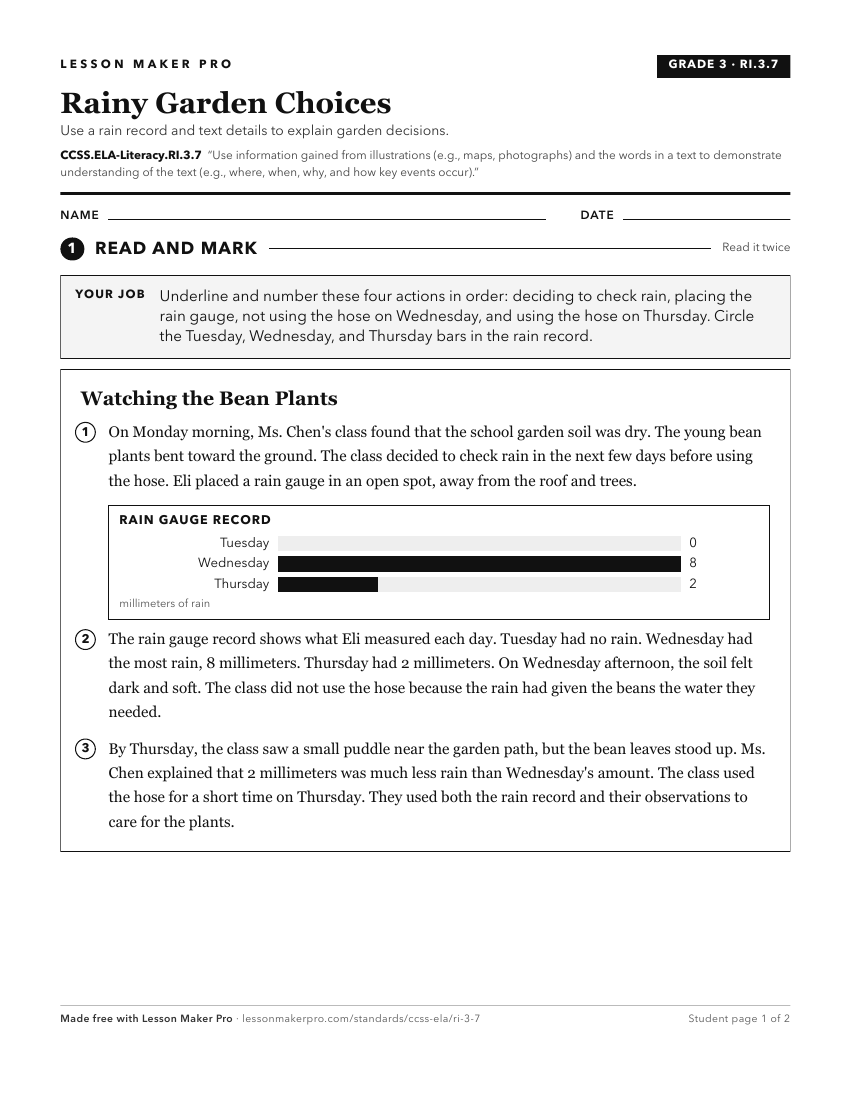
A ready-to-print activity worksheet aligned to CCSS.ELA-Literacy.RI.3.7, with an answer key for the teacher on its own page. No account needed.
PDF, US Letter, prints cleanly in black and white.
Download the worksheetLearning progression
Where This Standard Sits
See the whole path on the Reading: Informational Text progression map.
Before This Standard
If students are struggling here, check these first.
What This Unlocks
Mastery here sets students up for these next.
Keep exploring
Related Standards
- CCSS.ELA-Literacy.RL.1.7
Use illustrations and details in a story to describe its characters, setting, or events.
- CCSS.ELA-Literacy.RI.1.7
Use the illustrations and details in a text to describe its key ideas.
- CCSS.ELA-Literacy.RL.2.7
Use information gained from the illustrations and words in a print or digital text to demonstrate understanding of its characters, setting, or plot.
Turn this exact standard into a lesson
Grade, subject, topic, and the complete standard are prefilled. Create one free, no account needed.
Also for this standard:Make a WorksheetMake a QuizMake a Sub Lesson