CCSS.
The Standard
With prompting and support, read informational texts appropriately complex for grade 1.
Common Core State Standards for English Language Arts · Reading Standards for Informational Text
Teacher's field guide
What This Standard Means
What Students Need to Do
- Students read grade-level nonfiction with help from a teacher or partner. They use print, pictures, headings, and prompts to make sense of the information.
What Mastery Looks Like
- Students read a grade-level informational passage aloud or quietly with occasional teacher support. They use headings, pictures, and word-solving strategies to explain the topic and key facts.
Common Misconceptions
- Students may guess from pictures instead of checking the printed words. They may skip headings and captions, or stop when they meet one unfamiliar word.
How to Assess It
- Give each student a short grade-level page about an animal. Ask the student to read it with prompts, then name the topic and one fact.
Lesson moves
Ways to Teach It
Give pairs a short animal article, sticky notes, and pencils to mark headings, captions, unfamiliar words, and two facts.
After shared reading, ask, "Which text feature helped you most, and what did it help you understand?"
Play Prompt Partner, where students draw cards such as reread, check the picture, or break the word into parts while reading.
Read a simple weather report, then have students choose suitable clothing and point to two details that support their choice.
Free download
Printable RI.1.10 Worksheet
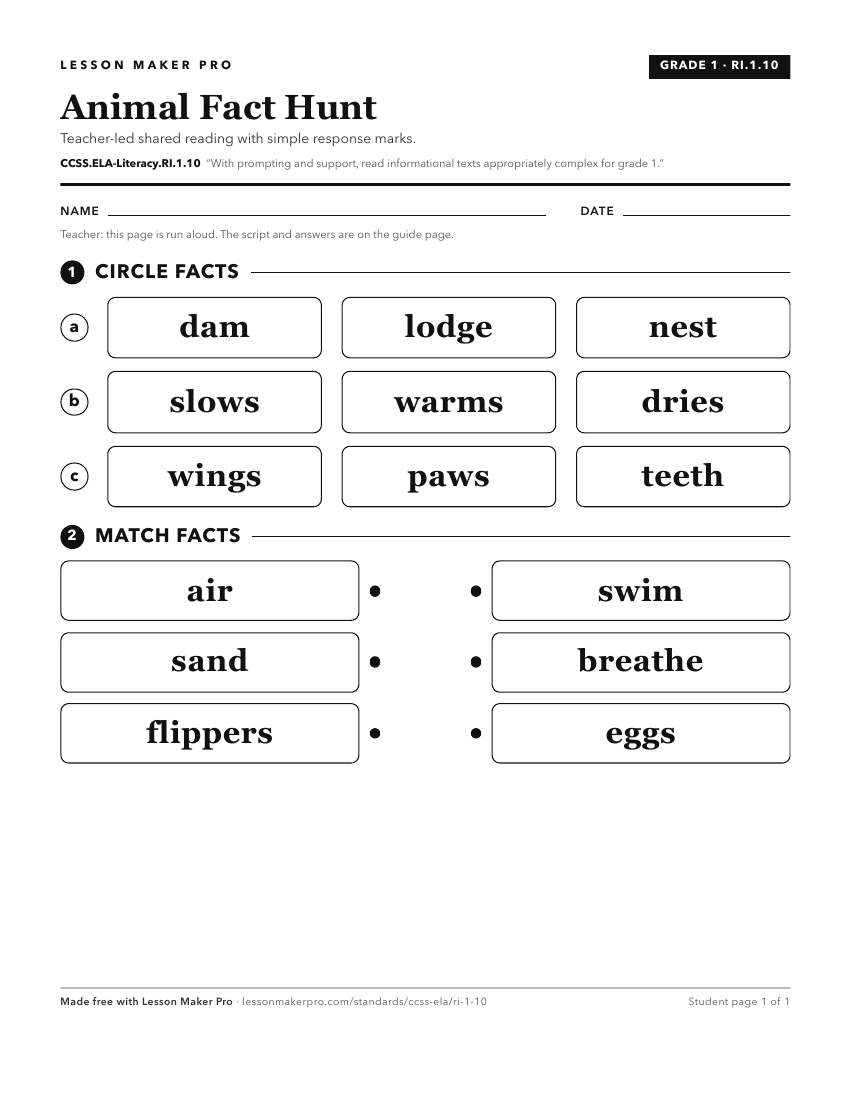
A ready-to-print activity worksheet aligned to CCSS.ELA-Literacy.RI.1.10, with an answer key for the teacher on its own page. No account needed.
PDF, US Letter, prints cleanly in black and white.
Download the worksheetLearning progression
Where This Standard Sits
See the whole path on the Reading: Informational Text progression map.
Before This Standard
If students are struggling here, check these first.
What This Unlocks
Mastery here sets students up for these next.
Keep exploring
Related Standards
- CCSS.ELA-Literacy.CCRA.R.10
Read and comprehend complex literary and informational texts independently and proficiently.
- CCSS.ELA-Literacy.RF.4.4
Read with sufficient accuracy and fluency to support comprehension.
- CCSS.ELA-Literacy.RL.1.10
With prompting and support, read prose and poetry of appropriate complexity for grade 1.
- CCSS.ELA-Literacy.RF.2.4
Read with sufficient accuracy and fluency to support comprehension.
Turn this exact standard into a lesson
Grade, subject, topic, and the complete standard are prefilled. Create one free, no account needed.
Also for this standard:Make a WorksheetMake a QuizMake a Sub Lesson