CCSS.
The Standard
Analyze the relationship between a primary and secondary source on the same topic.
Common Core State Standards for English Language Arts · Reading Standards for Literacy in History/Social Studies 6—12
Teacher's field guide
What This Standard Means
What Students Need to Do
- Students compare firsthand evidence with a later account of the same event or issue. They find where the sources agree, differ, or add context. They explain why those relationships matter.
What Mastery Looks Like
- Students correctly identify each source type and explain how the sources connect. They cite details showing agreement, added context, omission, or contradiction. They also explain how perspective or purpose may shape the differences.
Common Misconceptions
- Students may assume a primary source is always more accurate because it came from an eyewitness. They may summarize each source separately without connecting them. They may also mistake a later quotation of an eyewitness for a primary source.
How to Assess It
- Give students a short diary entry and a textbook paragraph about the same event. Ask them to name one agreement, one difference, and a reason for that difference.
Lesson moves
Ways to Teach It
Give pairs a protest photograph and a textbook account, then have them attach sticky notes marking agreements, differences, and missing details.
Ask students to write: How does the later account interpret the eyewitness evidence, and what details does it add or leave out?
Play Source Match by having teams pair primary source excerpts with secondary accounts and defend each match using two specific details.
Compare a recorded local news interview with a follow-up article, then discuss how the article selects and frames the speaker's words.
Free download
Printable RH.6-8.9 Worksheet
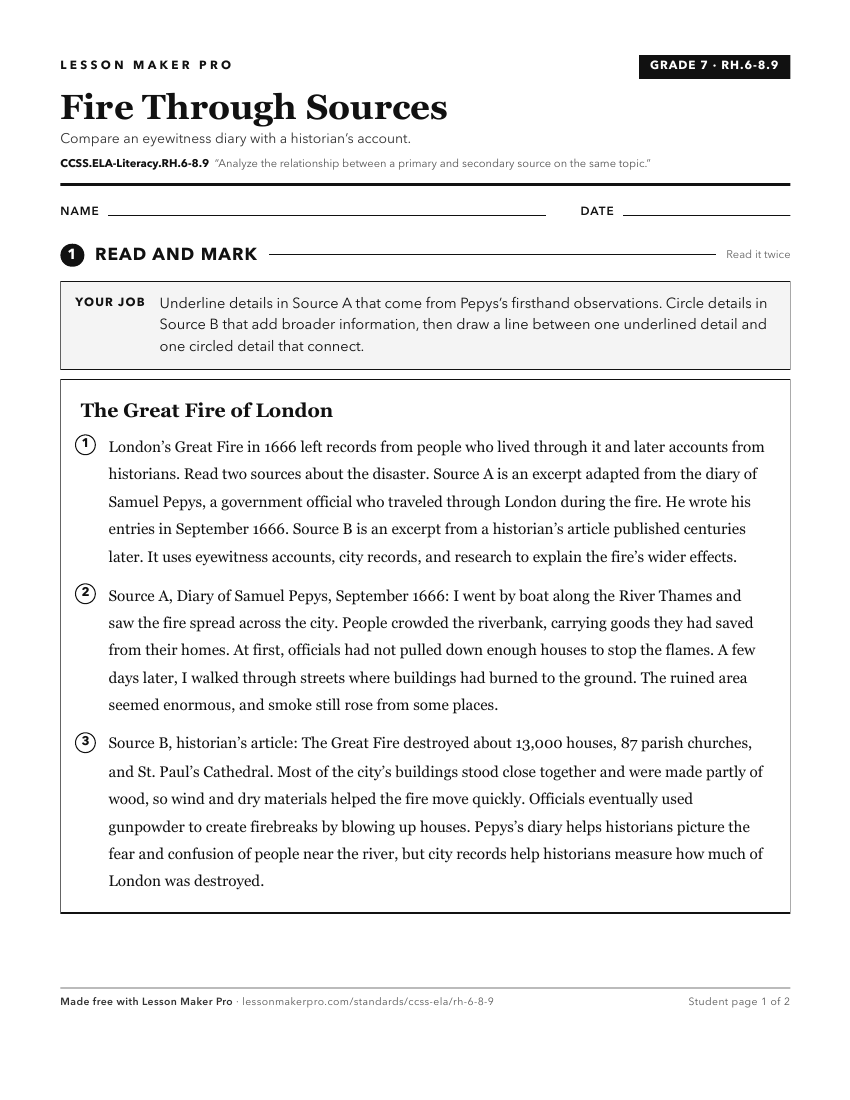
A ready-to-print activity worksheet aligned to CCSS.ELA-Literacy.RH.6-8.9, with an answer key for the teacher on its own page. No account needed.
PDF, US Letter, prints cleanly in black and white.
Download the worksheetKeep exploring
Related Standards
- CCSS.ELA-Literacy.RH.11-12.2
Determine the central ideas or information of a primary or secondary source; provide an accurate summary that makes clear the relationships among the key detail...
- CCSS.ELA-Literacy.RH.6-8.1
Cite specific textual evidence to support analysis of primary and secondary sources.
- CCSS.ELA-Literacy.RH.9-10.9
Compare and contrast treatments of the same topic in several primary and secondary sources.
- CCSS.ELA-Literacy.RH.11-12.5
Analyze in detail how a complex primary source is structured, including how key sentences, paragraphs, and larger portions of the text contribute to the whole.
Turn this exact standard into a lesson
Grade, subject, topic, and the complete standard are prefilled. Create one free, no account needed.
Also for this standard:Make a WorksheetMake a QuizMake a Sub Lesson