CCSS.
The Standard
Use knowledge of the meaning of individual words to predict the meaning of compound words (e.g., birdhouse, lighthouse, housefly; bookshelf, notebook, bookmark).
Common Core State Standards for English Language Arts
Teacher's field guide
What This Standard Means
What Students Need to Do
- Students break a compound word into two smaller words they know. They combine both meanings to make a sensible prediction, then check it against a sentence or picture.
What Mastery Looks Like
- A student can split words such as raincoat and toothbrush correctly. The student explains how each part supports the predicted meaning and revises a guess when context suggests another meaning.
Common Misconceptions
- Students may use only one word part, split at the wrong place, or assume every combination is literal. They may also split words with misleading chunks, such as carpet.
How to Assess It
- Exit ticket: “What do you think sunflower means? Circle the two smaller words and explain your prediction in one sentence.”
Lesson moves
Ways to Teach It
Give pairs word cards such as tooth and brush; students match cards, build compound words, and draw each meaning.
Ask, “How do the parts of pancake help, and where might they mislead us?” Students write two sentences.
Play Compound Word Memory with picture cards and word-part cards; students keep a match only after explaining the new word.
Have students inspect classroom objects such as notebooks, bookshelves, and backpacks, then label each with its two word parts.
Free download
Printable L.2.4d Worksheet
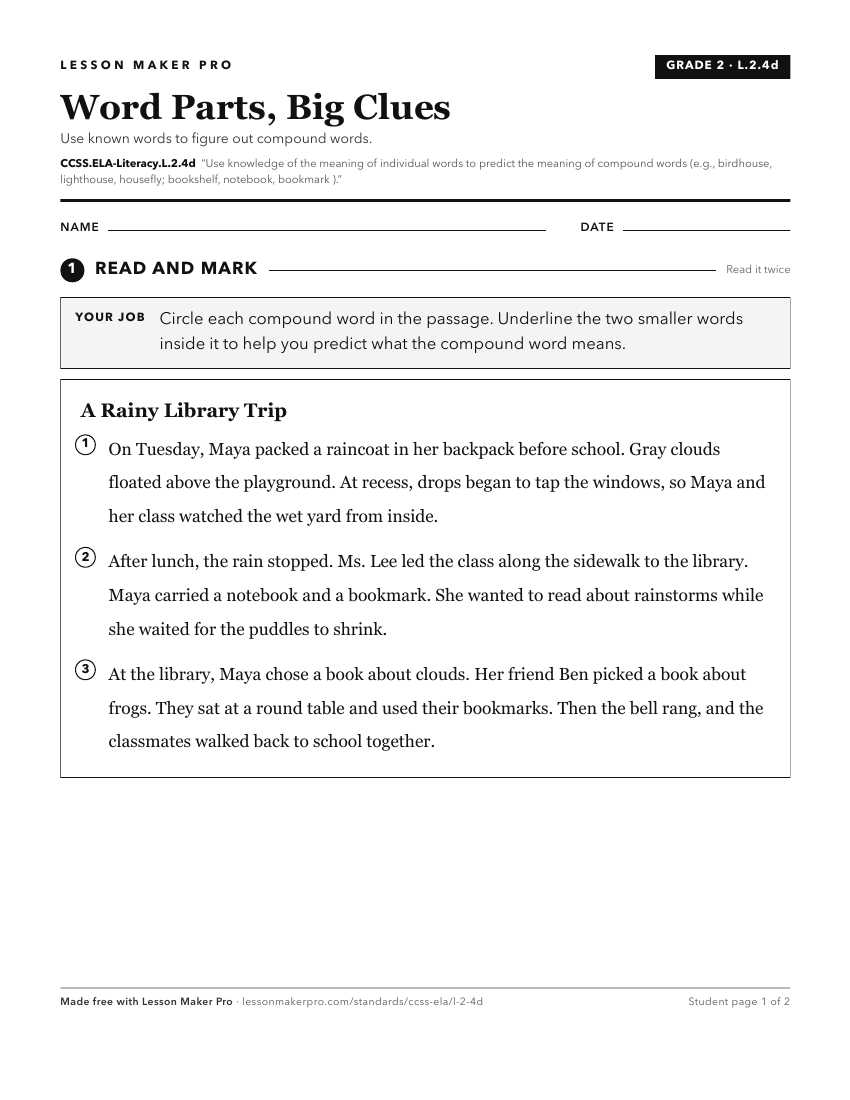
A ready-to-print activity worksheet aligned to CCSS.ELA-Literacy.L.2.4d, with an answer key for the teacher on its own page. No account needed.
PDF, US Letter, prints cleanly in black and white.
Download the worksheetKeep exploring
Related Standards
- CCSS.ELA-Literacy.L.5.5c
Use the relationship between particular words (e.g., synonyms, antonyms, homographs) to better understand each of the words.
- CCSS.ELA-Literacy.L.K.5c
Identify real-life connections between words and their use (e.g., note places at school that are colorful).
- CCSS.ELA-Literacy.L.1.5c
Identify real-life connections between words and their use (e.g., note places at home that are cozy).
- CCSS.ELA-Literacy.L.8.5b
Use the relationship between particular words to better understand each of the words.
Turn this exact standard into a lesson
Grade, subject, topic, and the complete standard are prefilled. Create one free, no account needed.
Also for this standard:Make a WorksheetMake a QuizMake a Sub Lesson