CCSS.
The Standard
Speak in complete sentences when appropriate to task and situation in order to provide requested detail or clarification.
Common Core State Standards for English Language Arts · Speaking and Listening Standards
Teacher's field guide
What This Standard Means
What Students Need to Do
- Students speak in complete sentences when answering questions, explaining ideas, or giving information. They adjust their response to include details when a listener needs more information.
What Mastery Looks Like
- Students answer questions with complete, clear sentences when the situation calls for detail. They can add a relevant reason, example, or explanation when a listener asks for clarification.
Common Misconceptions
- Students may answer with fragments such as “Because it was raining” or give one-word replies when more detail is needed. They may also add unrelated details instead of directly clarifying their idea.
How to Assess It
- Ask each student, “Which classroom job would you choose, and why?” Check for a complete sentence, a clear choice, and one relevant reason.
Lesson moves
Ways to Teach It
Give pairs picture cards and have one student build an object with blocks while describing each step in complete sentences.
Ask, “Should students have homework?” and require each speaker to state a claim and one reason in complete sentences.
Play Detail Detective, where partners earn a point by asking for clarification and replying with a complete, specific sentence.
Role-play ordering lunch, asking a librarian for help, or explaining a problem to the school nurse using clear, complete sentences.
Free download
Printable SL.3.6 Worksheet
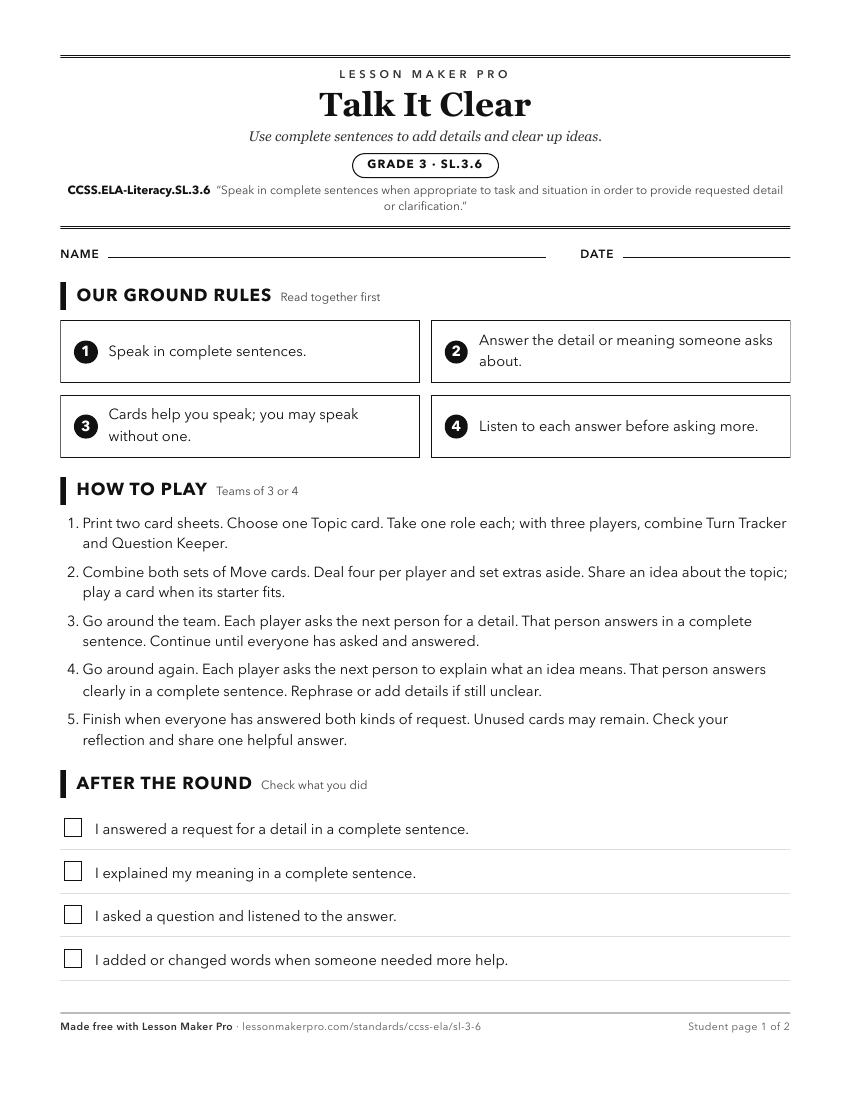
A ready-to-print activity worksheet aligned to CCSS.ELA-Literacy.SL.3.6, with an answer key for the teacher on its own page. No account needed.
PDF, US Letter, prints cleanly in black and white.
Download the worksheetLearning progression
Where This Standard Sits
See the whole path on the Speaking & Listening progression map.
Before This Standard
If students are struggling here, check these first.
What This Unlocks
Mastery here sets students up for these next.
Keep exploring
Related Standards
- CCSS.ELA-Literacy.SL.6.6
Adapt speech to a variety of contexts and tasks, demonstrating command of formal English when indicated or appropriate.
- CCSS.ELA-Literacy.SL.9-10.6
Adapt speech to a variety of contexts and tasks, demonstrating command of formal English when indicated or appropriate.
- CCSS.ELA-Literacy.SL.1.6
Produce complete sentences when appropriate to task and situation.
Turn this exact standard into a lesson
Grade, subject, topic, and the complete standard are prefilled. Create one free, no account needed.
Also for this standard:Make a WorksheetMake a QuizMake a Sub Lesson