CCSS.
The Standard
Analyze the structure of the relationships among concepts in a text, including relationships among key terms (e.g., force, friction, reaction force, energy).
Common Core State Standards for English Language Arts · Reading Standards for Literacy in Science and Technical Subjects 6—12
Teacher's field guide
What This Standard Means
What Students Need to Do
- Students trace how a science or technical text connects ideas through cause, effect, sequence, comparison, and part-to-whole links. They explain how terms work together rather than defining each separately.
What Mastery Looks Like
- Given a passage, students can build an accurate concept map, label each connection, and support it with specific sentences. They can explain how changing one concept affects the larger explanation.
Common Misconceptions
- Students often list definitions without showing connections, or assume nearby terms have the same relationship. They may confuse sequence with cause, reverse a link, or rely on prior knowledge instead of the passage.
How to Assess It
- Give students a short paragraph about force, friction, motion, and energy. Ask them to draw and label three links, then cite one sentence supporting each link.
Lesson moves
Ways to Teach It
Give pairs term cards and arrow labels; students arrange a concept map, then justify each arrow with a line from the text.
After reading a lab explanation, ask: Which concept depends on another, and what wording proves that relationship?
Play Connection Challenge: teams draw two term cards, name their relationship, and earn a point by citing accurate textual evidence.
Use a bicycle braking guide to connect friction, force, heat, and stopping distance in a labeled diagram.
Free download
Printable RST.9-10.5 Worksheet
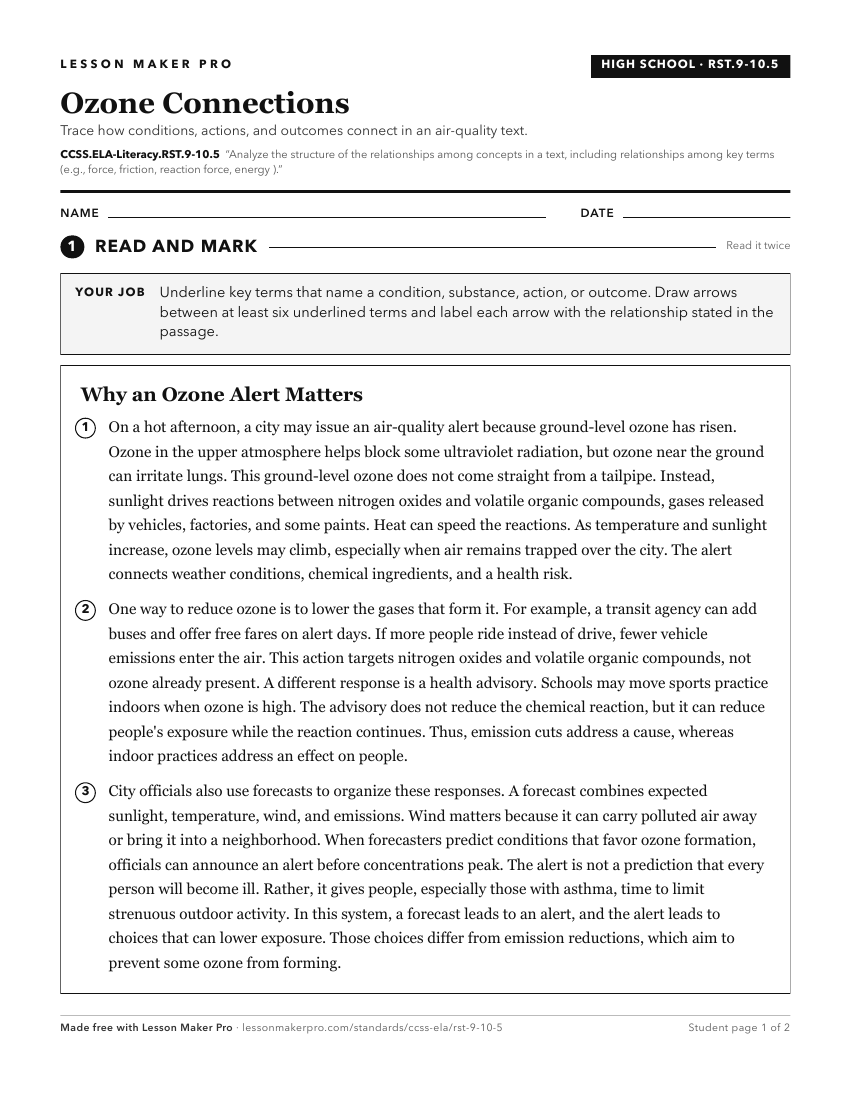
A ready-to-print activity worksheet aligned to CCSS.ELA-Literacy.RST.9-10.5, with an answer key for the teacher on its own page. No account needed.
PDF, US Letter, prints cleanly in black and white.
Download the worksheetLearning progression
Where This Standard Sits
See the whole path on the Reading: Science & Technical Subjects progression map.
What This Unlocks
Mastery here sets students up for these next.
Keep exploring
Related Standards
- CCSS.ELA-Literacy.CCRA.R.5
Analyze the structure of texts, including how specific sentences, paragraphs, and larger portions of the text (e.g., a section, chapter, scene, or stanza) relat...
- CCSS.ELA-Literacy.RI.5.3
Explain the relationships or interactions between two or more individuals, events, ideas, or concepts in a historical, scientific, or technical text based on sp...
- CCSS.ELA-Literacy.RI.7.3
Analyze the interactions between individuals, events, and ideas in a text (e.g., how ideas influence individuals or events, or how individuals influence ideas o...
- CCSS.ELA-Literacy.RI.8.3
Analyze how a text makes connections among and distinctions between individuals, ideas, or events (e.g., through comparisons, analogies, or categories).
Turn this exact standard into a lesson
Grade, subject, topic, and the complete standard are prefilled. Create one free, no account needed.
Also for this standard:Make a WorksheetMake a QuizMake a Sub Lesson