CCSS.
The Standard
Describe how a particular story's or drama's plot unfolds in a series of episodes as well as how the characters respond or change as the plot moves toward a resolution.
Common Core State Standards for English Language Arts · Reading Standards for Literature
Teacher's field guide
What This Standard Means
What Students Need to Do
- Students identify the major events that move a story or drama forward. They explain how characters react to those events and how their choices, feelings, or beliefs change before the ending.
What Mastery Looks Like
- Students can place major episodes in order and explain how each affects what happens next. They use details from the text to show how a character’s actions, feelings, or beliefs develop by the resolution.
Common Misconceptions
- Students may retell every event instead of selecting episodes that move the plot forward. They may name a character’s feeling without explaining what caused it or how the character changed. Some confuse the resolution with any final event.
How to Assess It
- Use an exit ticket: “Name three key events from the story. Explain how the main character responds to each and how those responses lead to the ending.”
Lesson moves
Ways to Teach It
Give groups event cards from a familiar story to sequence, then add sticky notes showing the main character’s response to each event.
Ask students to write: “Which event changes the main character most, and what details prove it?”
Play Plot Relay, where teams take turns adding one key event, its effect, and the character’s response to a shared chart.
Have students map a real-life conflict, listing what happened, how each person responded, and how those choices shaped the outcome.
Free download
Printable RL.6.3 Worksheet
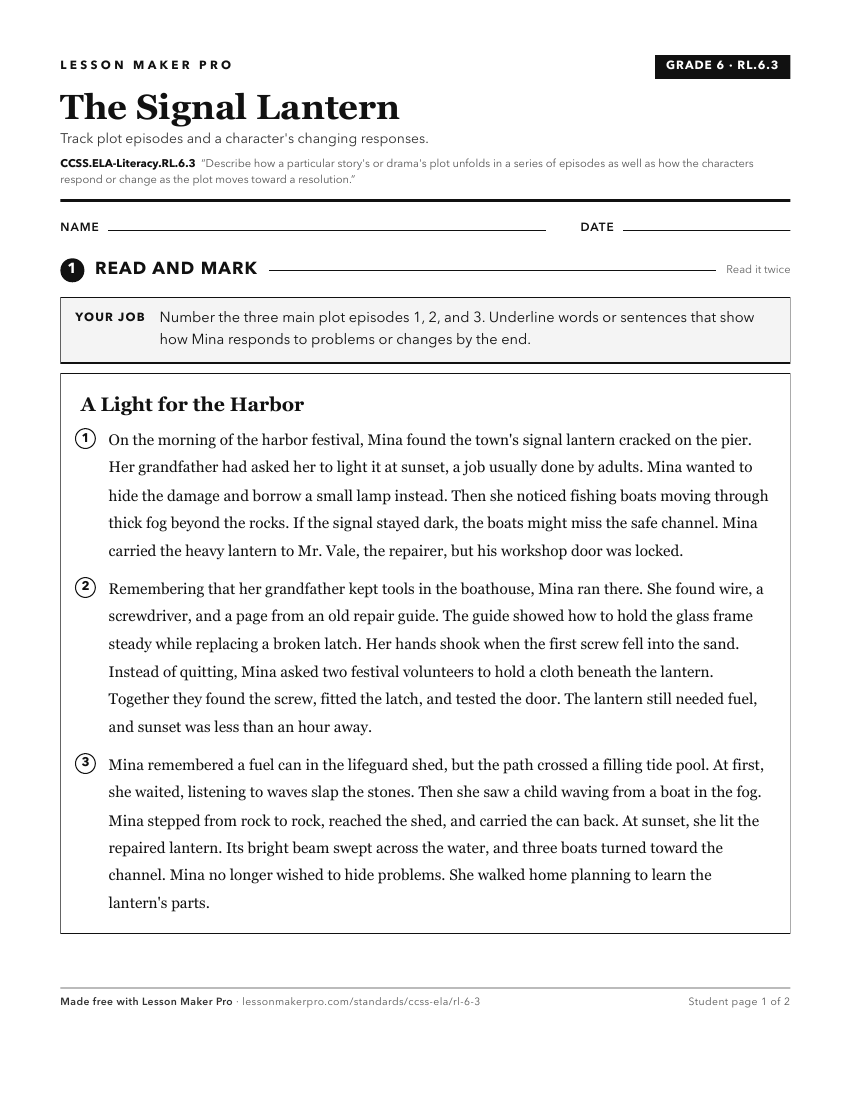
A ready-to-print activity worksheet aligned to CCSS.ELA-Literacy.RL.6.3, with an answer key for the teacher on its own page. No account needed.
PDF, US Letter, prints cleanly in black and white.
Download the worksheetLearning progression
Where This Standard Sits
See the whole path on the Reading: Literature progression map.
Before This Standard
If students are struggling here, check these first.
What This Unlocks
Mastery here sets students up for these next.
Keep exploring
Related Standards
- CCSS.ELA-Literacy.RL.5.5
Explain how a series of chapters, scenes, or stanzas fits together to provide the overall structure of a particular story, drama, or poem.
- CCSS.ELA-Literacy.RL.2.3
Describe how characters in a story respond to major events and challenges.
- CCSS.ELA-Literacy.RL.3.3
Describe characters in a story (e.g., their traits, motivations, or feelings) and explain how their actions contribute to the sequence of events.
Turn this exact standard into a lesson
Grade, subject, topic, and the complete standard are prefilled. Create one free, no account needed.
Also for this standard:Make a WorksheetMake a QuizMake a Sub Lesson