CCSS.
The Standard
Analyze in detail a series of events described in a text; determine whether earlier events caused later ones or simply preceded them.
Common Core State Standards for English Language Arts · Reading Standards for Literacy in History/Social Studies 6—12
Teacher's field guide
What This Standard Means
What Students Need to Do
- Students build an accurate sequence of events from a history or social studies text. They use text details to decide which events produced later outcomes.
What Mastery Looks Like
- A student can create an accurate event sequence and identify causal links. They explain how one event produced another and support the claim with specific text evidence.
Common Misconceptions
- Students often assume that an earlier event caused every event that followed. They may confuse a trigger with a deeper cause or ignore several causes working together.
How to Assess It
- Give students three events from today’s reading. Ask them to order the events, then explain whether the first caused the third using one text detail.
Lesson moves
Ways to Teach It
Give pairs event cards from a historical account to order, then have them draw arrows only between events with supported causal links.
Ask students to write: Which event changed what happened next, and which event only came before it? Support both choices with evidence.
Play Cause or Sequence: read event pairs aloud, and students hold up cause or sequence cards before explaining their choice.
Use a short news article to trace what happened, then identify which earlier actions contributed directly to the reported outcome.
Free download
Printable RH.9-10.3 Worksheet
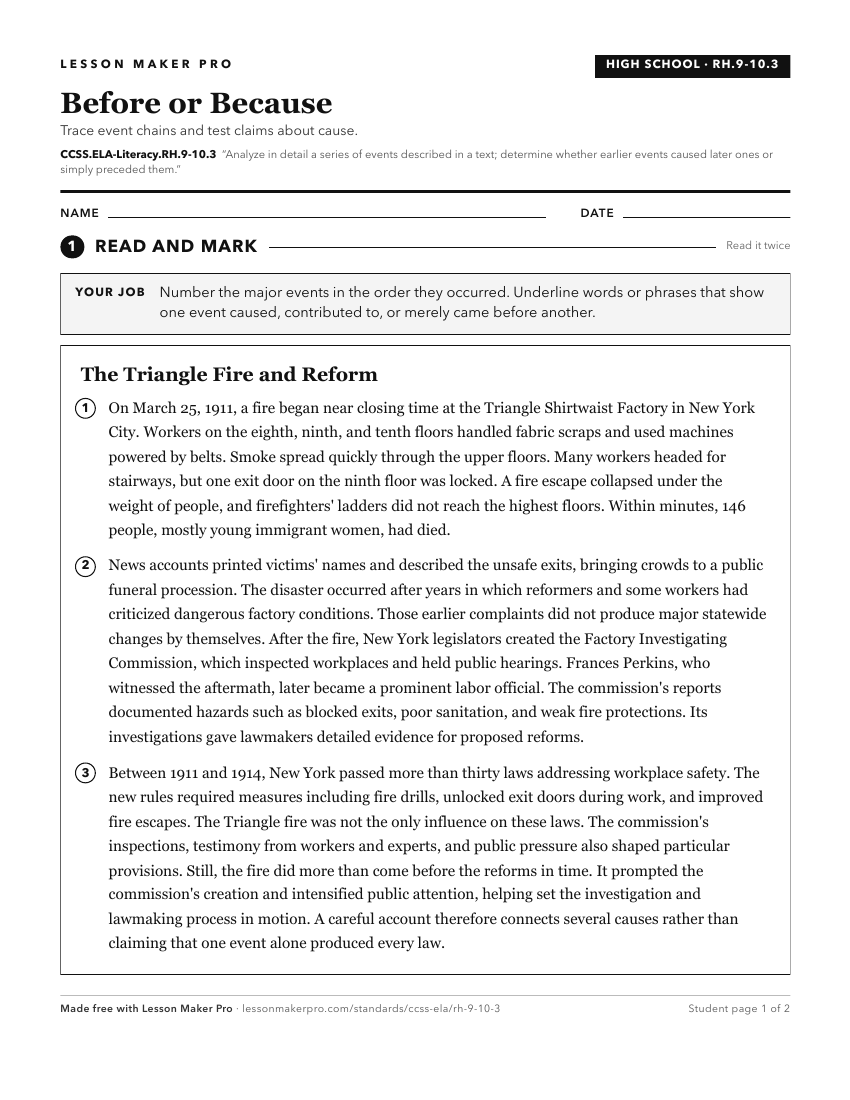
A ready-to-print activity worksheet aligned to CCSS.ELA-Literacy.RH.9-10.3, with an answer key for the teacher on its own page. No account needed.
PDF, US Letter, prints cleanly in black and white.
Download the worksheetLearning progression
Where This Standard Sits
See the whole path on the Reading: History/Social Studies progression map.
What This Unlocks
Mastery here sets students up for these next.
Keep exploring
Related Standards
- CCSS.ELA-Literacy.RI.9-10.3
Analyze how the author unfolds an analysis or series of ideas or events, including the order in which the points are made, how they are introduced and developed...
- CCSS.ELA-Literacy.RI.11-12.3
Analyze a complex set of ideas or sequence of events and explain how specific individuals, ideas, or events interact and develop over the course of the text.
- CCSS.ELA-Literacy.RI.7.3
Analyze the interactions between individuals, events, and ideas in a text (e.g., how ideas influence individuals or events, or how individuals influence ideas o...
- CCSS.ELA-Literacy.CCRA.R.3
Analyze how and why individuals, events, and ideas develop and interact over the course of a text.
Turn this exact standard into a lesson
Grade, subject, topic, and the complete standard are prefilled. Create one free, no account needed.
Also for this standard:Make a WorksheetMake a QuizMake a Sub Lesson