CCSS.
The Standard
- CCSS.ELA-Literacy.RF.4.3
- Know and apply grade-level phonics and word analysis skills in decoding words.
Use combined knowledge of all letter-sound correspondences, syllabication patterns, and morphology (e.g., roots and affixes) to read accurately unfamiliar multisyllabic words in context and out of context.
Common Core State Standards for English Language Arts
Teacher's field guide
What This Standard Means
What Students Need to Do
- Students decode unfamiliar multisyllabic words by using letter sounds, syllable patterns, roots, prefixes, and suffixes together. They read the words alone and within sentences, checking whether the pronunciation makes sense.
What Mastery Looks Like
- Students break unfamiliar long words into useful chunks, including syllables, roots, prefixes, and suffixes. They blend the parts, check the pronunciation in a sentence, and correct errors independently.
Common Misconceptions
- Students may guess from the first few letters or rely only on context. They may split syllables incorrectly, ignore affixes, or misread a vowel when its sound changes across related words.
How to Assess It
- Give students the words "miscalculation," "transportation," and "unbreakable." Ask them to mark meaningful parts and syllables, read each word aloud, then explain one decoding choice.
Adopted as
This framework is adopted as written in Connecticut, Delaware, District of Columbia, Michigan, Nevada, New Hampshire, Vermont, Wyoming.
- California: RF_4_3a
- Connecticut: CCSS.ELA-Literacy.RF.4.3a
- Delaware: CC4RF3a
- District of Columbia: CCSS.ELA-Literacy.RF.4.3a
- Michigan: CCSS.ELA-Literacy.RF.4.3a
- Montana: CCSS.ELA-Literacy.RF.4.3a
- Nevada: CCSS.ELA-Literacy.RF.4.3a
- New Hampshire: CCSS.ELA-Literacy.RF.4.3a
- New Mexico: CCSS.ELA-Literacy.RF.4.3a
- New York: 4RF3.a
State teaching guidance: By the end of grade 4, students should read and comprehend literary and informational texts at or above grade level. Distinguish word-reading fluency and independent-comprehension practice from teacher-led texts that build language and knowledge, and provide scaffolding for access to complex texts. (Grade guidance, p. 55.) Use this component with the complete New York 4RF3 requirement and its other components. A matching component does not establish equivalence of the entire national family. (NY component, p. 57.) New York State Next Generation English Language Arts Learning Standards (2017), page 55. Check shared national resources against this guidance before use.
- Vermont: CCSS.ELA-Literacy.RF.4.3a
- Washington: CCSS.ELA-Literacy.RF.4.3a
- Wyoming: CCSS.ELA-Literacy.RF.4.3a
Lesson moves
Ways to Teach It
Give pairs word-part cards for prefixes, roots, and suffixes, then have them build, divide, and read words such as disagreement.
Ask students to write how they would decode transportation, naming the chunks they notice and the vowel sounds they choose.
Play a word-sorting relay where teams group multisyllabic words by prefix, suffix, root, or syllable pattern, then read each word aloud.
Use words from a science article, such as evaporation and condensation, and have students mark chunks before reading the paragraph aloud.
Free download
Printable RF.4.3a Worksheet
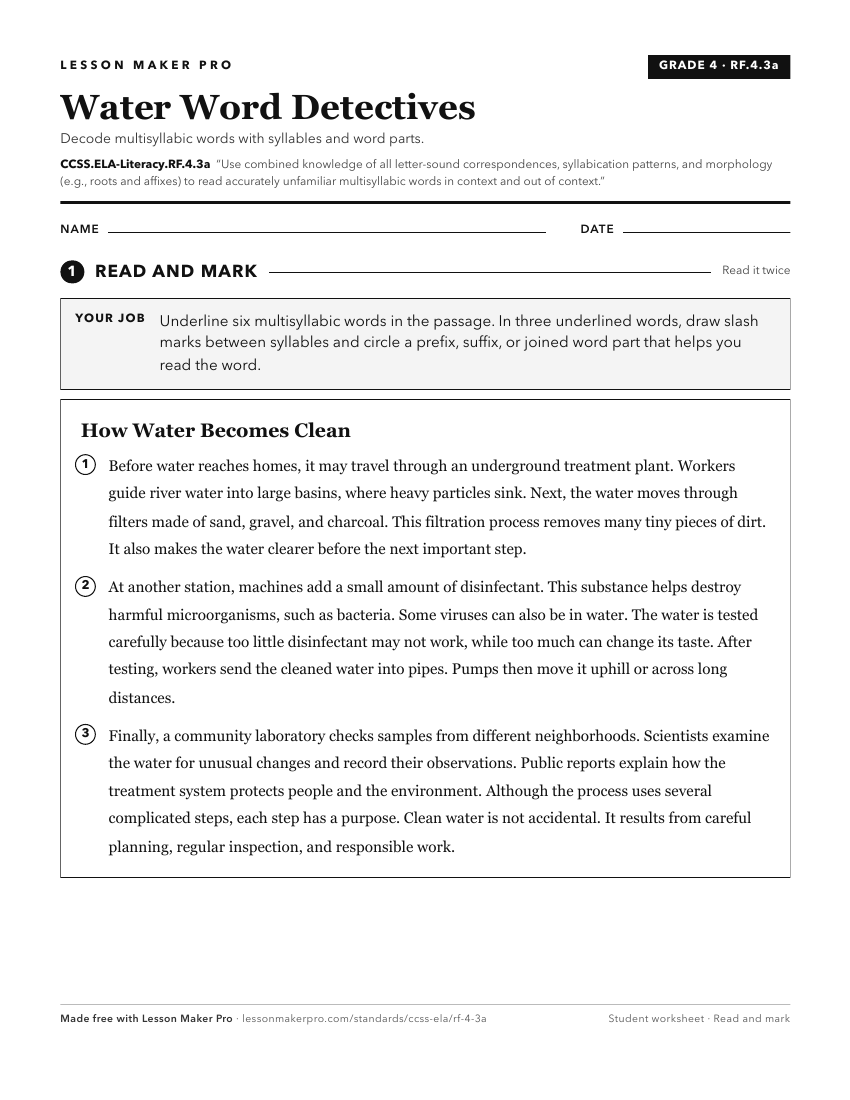
A ready-to-print activity worksheet aligned to CCSS.ELA-Literacy.RF.4.3a, with an answer key for the teacher on its own page. No account needed.
PDF, US Letter, prints cleanly in black and white.
Download the worksheetLearning progression
Where This Standard Sits
Before This Standard
If students are struggling here, check these first.
What This Unlocks
Mastery here sets students up for these next.
Keep exploring
Related Standards
Turn this exact standard into a lesson
Grade, subject, topic, and the complete standard are prefilled. Create one free, no account needed.
Also for this standard:Make a WorksheetMake a QuizMake a Sub Lesson