CCSS.
The Standard
- CCSS.ELA-Literacy.RF.1.1
- Demonstrate understanding of the organization and basic features of print.
Recognize the distinguishing features of a sentence (e.g., first word, capitalization, ending punctuation).
Common Core State Standards for English Language Arts
Teacher's field guide
What This Standard Means
What Students Need to Do
- Students locate where each sentence starts and stops in print. They identify the first word, its capital letter, and the punctuation mark at the end.
What Mastery Looks Like
- Students can find each complete sentence in a short passage, even when a sentence continues onto another line. They correctly mark its beginning, capital letter, and ending punctuation.
Common Misconceptions
- Students may treat each printed line as a new sentence. They may look for any capital letter instead of checking the first word. They may overlook ending punctuation or confuse periods, question marks, and exclamation points.
How to Assess It
- Give students three printed sentences. Ask them to circle each first word, underline its capital letter, and box the ending punctuation.
Adopted as
This framework is adopted as written in Connecticut, Delaware, District of Columbia, Michigan, Nevada, New Hampshire, Vermont, Wyoming.
- Alabama: 1_LF_32_a
- California: RF_1_1a
- Connecticut: CCSS.ELA-Literacy.RF.1.1a
- Delaware: CC1RF1a
- District of Columbia: CCSS.ELA-Literacy.RF.1.1a
- Indiana: 1_RF_1
- Michigan: CCSS.ELA-Literacy.RF.1.1a
- Montana: CCSS.ELA-Literacy.RF.1.1a
- Nevada: CCSS.ELA-Literacy.RF.1.1a
- New Hampshire: CCSS.ELA-Literacy.RF.1.1a
- New Mexico: CCSS.ELA-Literacy.RF.1.1a
- New York: 1RF1.a
State teaching guidance: Match word-reading practice to each learner’s phonics and decoding skills. Also provide age-appropriate, content-rich complex texts and interactive read-alouds that may exceed independent reading ability. Scaffold access to grade-level texts; comprehension experiences need not be limited to independently decodable material. (Grade guidance, p. 28.) Use this component with the complete New York 1RF1 requirement and its other components. A matching component does not establish equivalence of the entire national family. (NY component, p. 30.) New York State Next Generation English Language Arts Learning Standards (2017), page 28. Check shared national resources against this guidance before use.
- Oklahoma: 1_2_PC_1
- South Dakota: 1_RF_1_b
- Vermont: CCSS.ELA-Literacy.RF.1.1a
- Washington: CCSS.ELA-Literacy.RF.1.1a
- Wyoming: CCSS.ELA-Literacy.RF.1.1a
Lesson moves
Ways to Teach It
Give students word and punctuation cards, then have them build sentences and label each beginning and ending.
Display a short sentence and ask, "How does the print show where this sentence starts and stops?"
Play Sentence Detective by having students circle first words and box ending marks in a short paragraph.
Examine a classroom sign or food package and identify how its printed sentences begin and end.
Free download
Printable RF.1.1a Worksheet
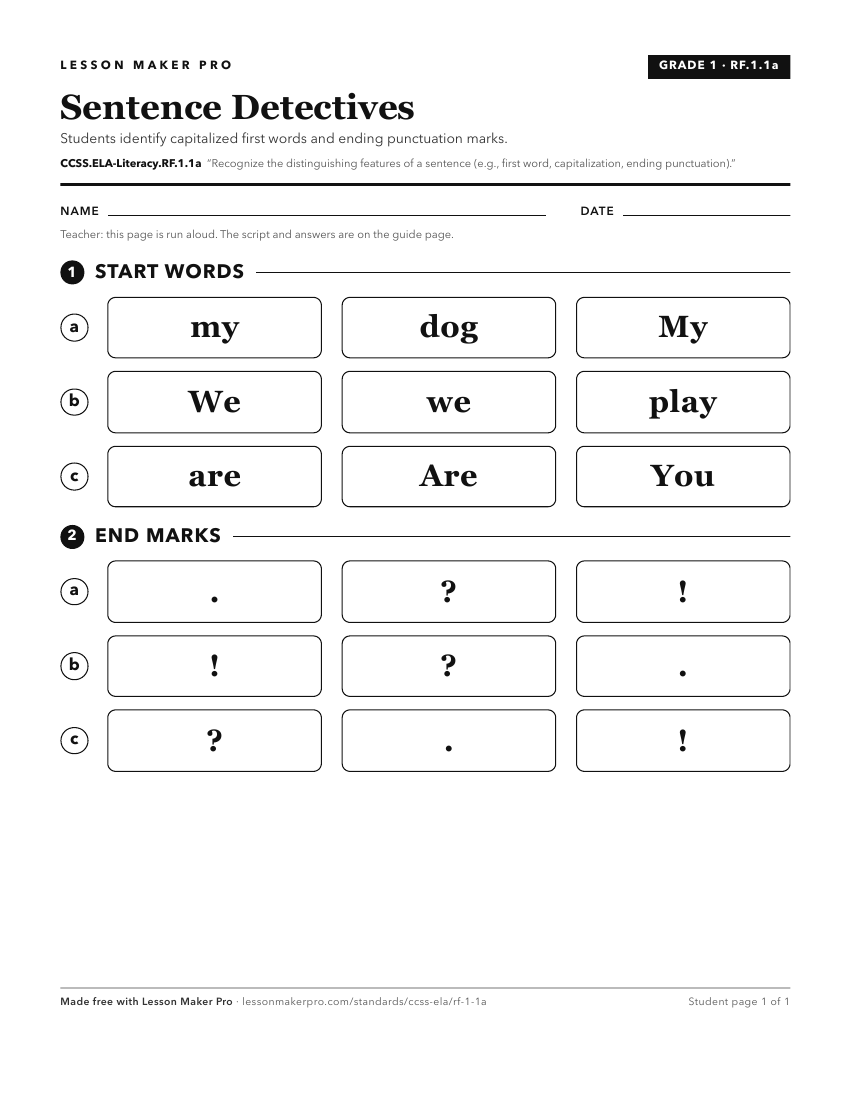
A ready-to-print activity worksheet aligned to CCSS.ELA-Literacy.RF.1.1a, with an answer key for the teacher on its own page. No account needed.
PDF, US Letter, prints cleanly in black and white.
Download the worksheetLearning progression
Where This Standard Sits
Before This Standard
If students are struggling here, check these first.
Keep exploring
Related Standards
- CCSS.ELA-Literacy.L.K.2b
Recognize and name end punctuation.
- CCSS.ELA-Literacy.L.1.2b
Use end punctuation for sentences.
- CCSS.ELA-Literacy.CCRA.L.2
Demonstrate command of the conventions of standard English capitalization, punctuation, and spelling when writing.
- CCSS.ELA-Literacy.L.11-12.2
Demonstrate command of the conventions of standard English capitalization, punctuation, and spelling when writing.
Turn this exact standard into a lesson
Grade, subject, topic, and the complete standard are prefilled. Create one free, no account needed.
Also for this standard:Make a WorksheetMake a QuizMake a Sub Lesson