CCSS.
The Standard
Compare formal and informal uses of English.
Common Core State Standards for English Language Arts
Teacher's field guide
What This Standard Means
What Students Need to Do
- Students notice how word choice changes with the audience and setting. They compare casual and more polite versions of a message, then choose wording that fits.
What Mastery Looks Like
- Students can label two versions of the same message and point to words that create each tone. They can rewrite a message for a different audience without changing its meaning.
Common Misconceptions
- Students may think informal language is always wrong or rude. They may also assume formal language must use long words and never include contractions.
How to Assess It
- Give students two requests: “Can I borrow your pencil?” and “Yo, give me that pencil.” Ask which fits a new teacher and why.
Lesson moves
Ways to Teach It
Sort phrase cards into “talking with a friend” and “speaking to the principal,” then explain one choice.
Rewrite “Hey, gimme that book” as a request to a librarian, then discuss which words make it respectful.
Role-play audience cards and earn a point for choosing wording that fits each person and setting.
Compare a school invitation with a family text message, noticing differences in greetings, word choice, and closing.
Free download
Printable L.2.3a Worksheet
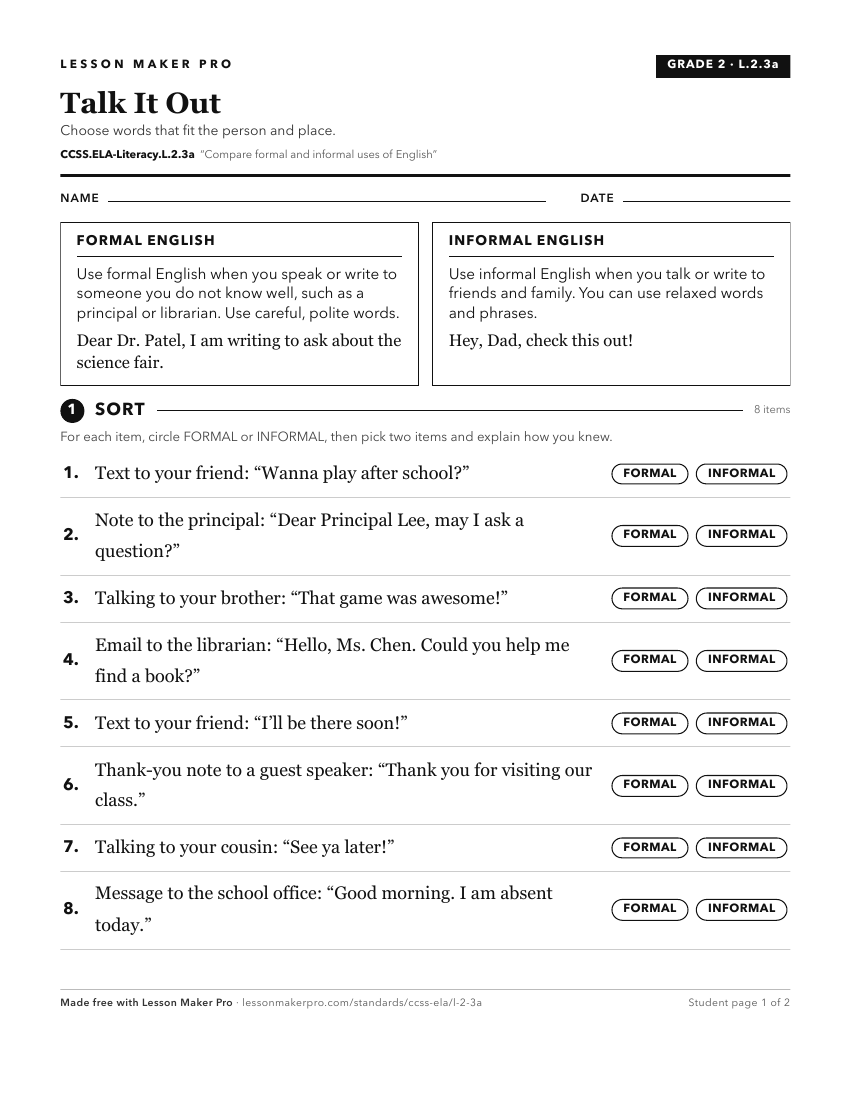
A ready-to-print activity worksheet aligned to CCSS.ELA-Literacy.L.2.3a, with an answer key for the teacher on its own page. No account needed.
PDF, US Letter, prints cleanly in black and white.
Download the worksheetLearning progression
Where This Standard Sits
What This Unlocks
Mastery here sets students up for these next.
Keep exploring
Related Standards
- CCSS.ELA-Literacy.SL.5.6
Adapt speech to a variety of contexts and tasks, using formal English when appropriate to task and situation.
- CCSS.ELA-Literacy.L.4.3c
Differentiate between contexts that call for formal English (e.g., presenting ideas) and situations where informal discourse is appropriate (e.g., small-group d...
- CCSS.ELA-Literacy.SL.8.6
Adapt speech to a variety of contexts and tasks, demonstrating command of formal English when indicated or appropriate.
- CCSS.ELA-Literacy.SL.4.6
Differentiate between contexts that call for formal English (e.g., presenting ideas) and situations where informal discourse is appropriate (e.g., small-group d...
Turn this exact standard into a lesson
Grade, subject, topic, and the complete standard are prefilled. Create one free, no account needed.
Also for this standard:Make a WorksheetMake a QuizMake a Sub Lesson